Know Exactly How Much Concrete to Buy for Your Next Pour
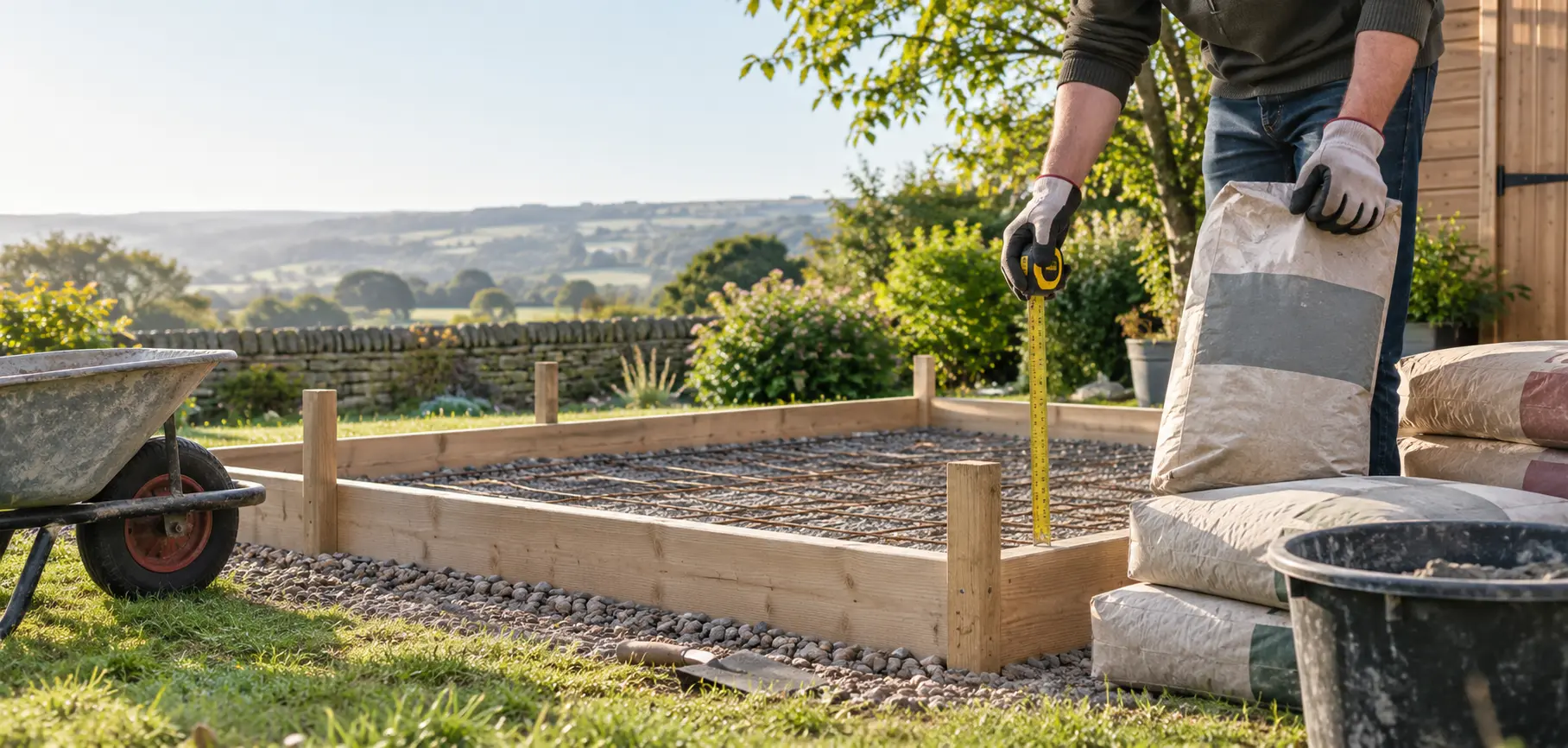
The annoying part of a concrete job often starts before mixing. You have measured the space, yet the shelf offers three bag sizes and five promises. Buy too few, and a half-finished slab waits while you drive back. Buy too many, and your shed becomes a storage unit for stone-heavy leftovers. Nobody wants a Sunday dash for more bags while the first batch stiffens.
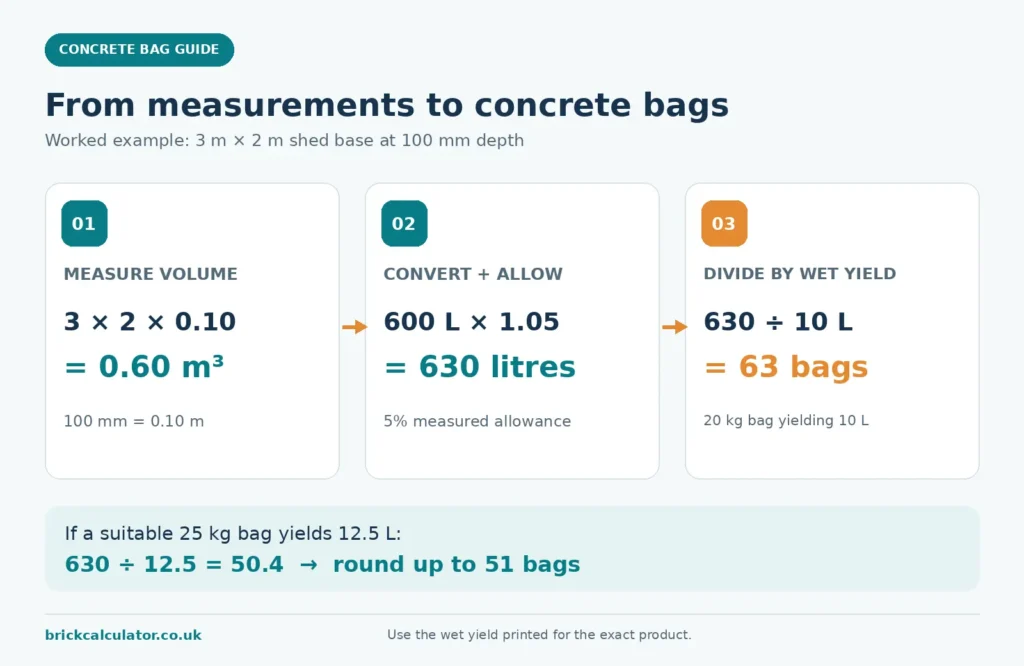
How many bags of concrete do I need? Multiply the pour’s dimensions to find cubic metres. Convert that volume to litres, allow for reasonable waste, then divide by the exact bag’s wet yield. Round up to a whole bag. For a 3 m by 2 m slab, 100 mm thick, 600 litres becomes 630 litres with 5% allowance. A mix yielding 10 litres per bag needs 63 bags.
That sounds simple. The trap lies in the words “per bag.” Two bags can weigh the same and produce different volumes. Let’s price and plan the pour using the number that actually matters.
How do I calculate the number of bags?
Here is the short answer you can use beside a tape measure. Keep every dimension in metres before multiplying. Divide millimetres by 1,000. One cubic metre equals 1,000 litres.
Ask, “How many bags of concrete do I need?” The missing detail is usually the final wet yield. Find it before buying.
Bags = round up [(length × width × depth × 1,000 × (1 + waste fraction)) ÷ wet yield per bag in litres].
For example, a 2 m by 1 m pad at 100 mm depth holds 200 litres. At 10 litres per 20 kg bag, that means 20 bags before waste. Add 5%, and 210 litres calls for 21 bags. Always round after dividing. Concrete sellers cannot usually supply the last 0.3 of a sealed bag.
The method also works for an irregular area. Split it into rectangles, calculate each volume, then add them. For a curved edge, take several width measurements and use a sensible average. A tidy formula cannot rescue a wildly inaccurate excavation.
Why can’t I use bag weight alone?
Because kilograms describe dry mass, while your hole needs wet volume. Water demand, aggregate grading, and the particular blend change the final yield. The label or technical sheet should state litres of mixed concrete per full bag.
I have seen calculators make the question look settled. How many bags of concrete do I need still depends on the bag you choose.
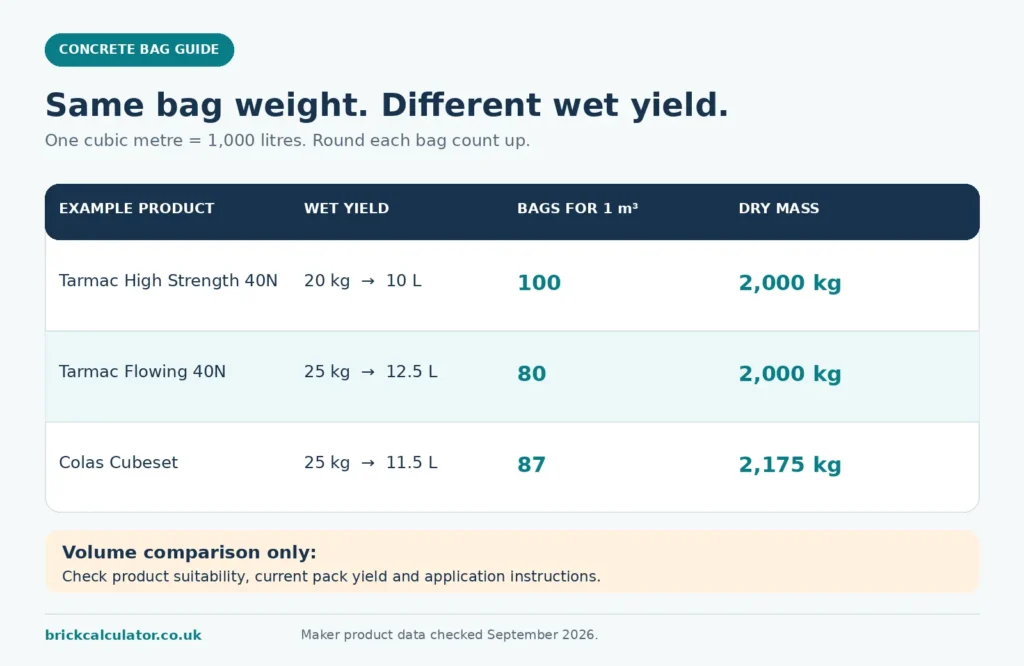
During this research, I caught my own shortcut. I first treated every 25 kg bag as 12.5 litres. Then I checked two manufacturers. Tarmac lists about 12.5 litres for one flowing 25 kg mix. Colas says its 25 kg Cubeset yields about 11.5 litres. That one-litre difference adds up fast across a slab.
Tarmac’s High Strength 40N data sheet, dated February 2018, gives roughly 10 litres from a 20 kg bag. Those three figures are product examples, not a universal rule. Check the current package before checkout. The rapid repair product also has different handling, so choose a suitable mix first.
Our concrete calculator shows the volume and bag estimate. Its presets cannot know which exact bag sits in your trolley. Check the maker’s wet yield before you buy.
What does one cubic metre look like in bags?
| Exact product yield | Bags for 1 m³ | Approx dry mass | What to check |
|---|---|---|---|
| 20 kg, 10 L | 100 | 2,000 kg | Tarmac High Strength example |
| 25 kg, 12.5 L | 80 | 2,000 kg | Tarmac Flowing example |
| 25 kg, 11.5 L | 87 | 2,175 kg | Colas Cubeset example |
Method: 1 m³ is 1,000 litres. Divide by the stated wet yield and round up. These quantities exclude allowance and compare only volume. They do not imply equal strength, suitability, price, or mixing water.
Why does the third row need seven more bags?
Eighty bags at 12.5 litres make 1,000 litres. Eighty bags at 11.5 litres make only 920. Another seven bags bring that second mix beyond 1,000 litres. This is why a generic “25 kg coverage” chart can mislead.
How should I measure a slab, path, or shed base?
- Mark the finished length and width. Measure the space you will actually fill, inside the formwork.
- Check depth at several spots. Use the deepest relevant measurements if the subbase varies.
- Convert depth to metres. A 75 mm layer is 0.075 m, while 100 mm is 0.1 m.
- Multiply for cubic metres. Then account for drains, voids, slopes, and separate sections.
- Add a measured allowance. Finally, divide by the specific bag’s litre yield and round up.
I would spend an extra five minutes checking depth before arguing over a 5% versus 10% waste allowance. A 10 mm depth mistake across 6 m² changes the pour by 60 litres. That equals six bags at 10 litres each. The arithmetic is honest, but the ground may not be.
Keep the compacted subbase separate from concrete depth. Still need crushed stone? Plan that layer with the aggregate calculator. Do not buy concrete to fill a layer intended for aggregate.
Ask “How many bags of concrete do I need?” only after marking the real finished level. That mark keeps the depth honest.
Case study: A 3m x 2m garden shed base
Take a planned 3m by 2m base, 100mm thick. The geometric volume is 0.6 m³, or 600 litres. Add 5% for modest edge variation and spillage. Your purchasing target becomes 630 litres.
At 10 litres per 20 kg bag, buy 63 bags. At 12.5 litres per 25 kg bag, 50.4 becomes 51 bags. At 11.5 litres, 54.78 becomes 55 bags. Those are three different shopping lists for the same slab.
This is a worked planning case, not a claim that I poured this base. The result changes if the actual depth changes. At 110 mm, its 5% target reaches 693 litres. That takes 70 of the 10-litre bags. Seven extra bags came from a depth difference you could measure before ordering.
Now picture moving 63 bags. That is 1,260 kg of dry material before adding water. A wheelbarrow, mixer, helper, and continuous working plan matter as much as the calculator. For structural bases, follow a suitable design and local requirements.
How many bags do fence post holes need?
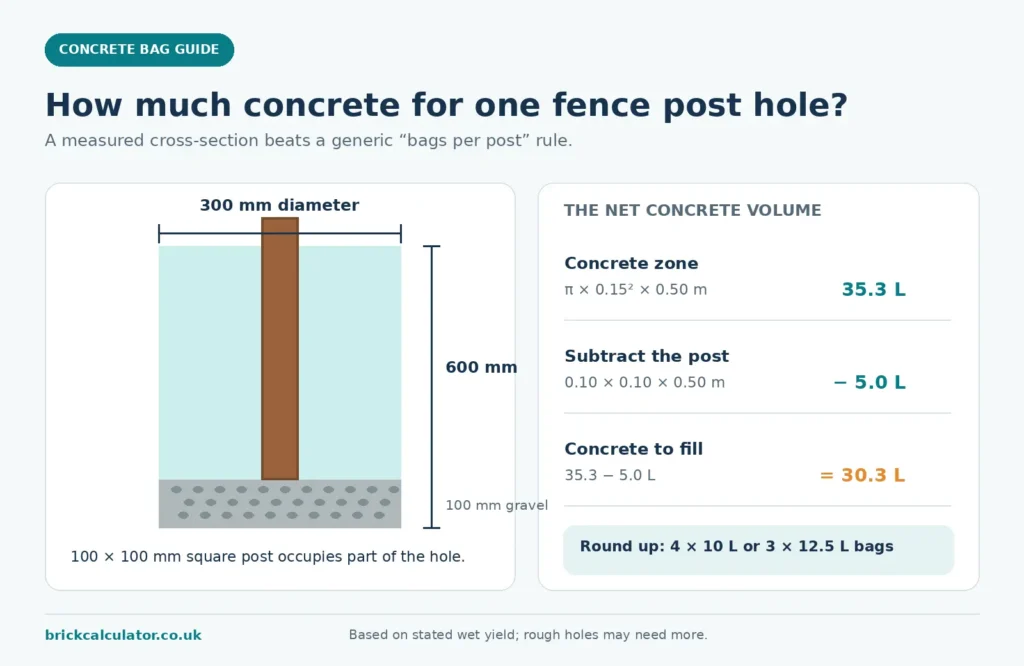
Post holes need one more subtraction. First calculate the round hole. Then remove any gravel layer and the volume occupied by the post. Pouring around timber does not require concrete inside the timber.
Case study: a 300 mm round hole with a square post
Suppose the hole measures 300 mm across and 600 mm deep. You put 100 mm of gravel at its base. A 100 mm square post reaches through the remaining 500 mm concrete zone. The concrete cylinder holds about 35.3 litres. The post displaces 5 litres. You need roughly 30.3 litres per hole.
That means four 10-litre bags per hole or three 12.5-litre bags per hole. The second answer is 37.5 litres, leaving room for irregular sides. Four identical holes need about 121.4 litres by geometry. Bulk rounding gives 13 ten-litre bags, but separate four-bag batches mean 16. Your method of batching and usable leftovers changes the purchase count.
Should I round per hole or across the whole fence?
Round across all holes if you can move fresh concrete between them in time. Round each hole if batches stay separate. Check the product’s working time first. A fast-setting mix can turn a small paper saving into a messy race.
Do not assume every post needs the same depth. Ground conditions, fence height, wind exposure, and local guidance may change the design. Postcrete or rapid-setting post mix has its own yield and placement instructions.
For posts, “How many bags of concrete do I need?” means per hole first, then for the whole fence. Keep those totals separate.
Should I add 10% extra concrete every time?
No. Ten percent is a convenient allowance, not a repair for poor measurements. A clean, square form on level ground may justify around 5%. A rough trench or variable excavation may need more. Record the reason for the allowance before you choose it.
Start with the actual depth and area. Then ask where material could go: uneven edges, spillages, residue in the mixer, and formwork movement. If the pour is split into many small holes, round at the practical batch size. Extra bags can save an urgent shop trip. They also cost money and take space.
This is my least fashionable concrete opinion: a careful measurement beats a generous percentage. The percentage feels reassuring because it is one click. It does not tell you whether the trench is 90 mm or 130 mm deep.
When should I order ready-mixed concrete instead of bags?
There is no magic one-cubic-metre cutoff. Compare three real routes for your postcode: premixed bags, site-mixed ingredients, and delivered ready-mixed concrete. Include delivery minimums, short-load charges, pump or barrow access, tools, labour, and time.
Divide the total bag cost by usable wet litres. A £6 bag yielding 10 litres costs 60 pence per litre before delivery or labour. A £7 bag yielding 12.5 litres costs 56 pence per litre. The second sticker looks worse, yet its concrete costs less per litre. These prices are illustrations, not current quotes.
The other hidden cost is pour continuity. A big slab may demand steady placing and finishing. If your crew cannot manage dozens of batches, get a truck quote. Its material line may look dearer.
A supplier may ask, “How many bags of concrete do I need?” That question helps compare bags. For a delivery quote, give cubic metres and site access instead.
In August 2026, the Mineral Products Association reported a 9.3% fall in Great Britain’s ready-mix sales. That compared the first half with 2025. London fell 27%. Demand data cannot tell you your local price. Get current quotes near the site.
My prediction for 2027: better bag calculators will ask for litres per bag before showing a shopping list. That small change could prevent more wasted money than another polished coverage chart.
Am I buying cement, concrete mix, or post mix?
This distinction causes expensive mistakes. Cement is a binder. Concrete contains cement, sand, coarse aggregate, and water. A premixed concrete bag contains the dry ingredients for concrete. Some bags need water and mechanical mixing. Post mix may be designed for direct placement or rapid setting.
A 25 kg cement bag cannot be treated as a 25 kg concrete bag in this calculation. You must design and measure the other ingredients too. Likewise, a bulk bag of ballast is an ingredient, not a cubic metre of finished concrete. Product names on retail shelves can sound deceptively similar.
Read the application, compressive strength, minimum layer thickness, water amount, working time, and curing directions. Colas says Cubeset offers only about 15 minutes of working time. That is helpful for some repairs and awkward for a long, leisurely slab pour.
What should I check before opening the first bag?
- Confirm the final dimensions, bag count, product suitability, and current pack yield.
- Set out all tools, clean water, a mixing area, and a route to the pour.
- Keep unopened bags dry. Check age, damage, and the maker’s storage advice.
- Follow the water quantity. Extra water can change performance and finish.
- Plan finishing and curing for the actual weather, not a generic afternoon.
- Protect skin and eyes. Wash wet cement off promptly and use suitable gloves and boots.
The UK Health and Safety Executive explains that wet cement can reach pH 12 to 13. It can cause serious burns. That warning deserves a place next to the bag estimate, not in tiny print after the job.
Tarmac’s High Strength sheet calls for about 2.25 litres of water per 20 kg bag. It also gives temperature and curing guidance. Use your own product sheet, since another blend may need different handling.
Frequently Asked Questions (FAQ’s)?
What is the smartest final check?
Write down four numbers: measured cubic metres, allowance, exact wet litres per bag, and the rounded bag count. Then check the label again at pickup. A changed product can change the answer even when the dimensions stay fixed.
How many bags of concrete do I need? For the 3 m by 2 m shed base above, buy 63 with a 10-litre bag. That includes a 5% allowance. Choose an 11.5-litre bag, and it becomes 55. The real win is knowing why.
Sources and further reading
Tarmac, High Strength 40N technical data sheet, February 2018. Manufacturer data supports the 20 kg yield and mixing water.
Colas, Cubeset product data, accessed September 2026. Manufacturer data supports the 25 kg yield and working time.
UK Health and Safety Executive, cement and skin safety advice, updated March 2026. Government guidance explains wet cement burns.
Mineral Products Association, quarterly sales release, 3 August 2026. Industry association data supports the first-half ready-mix figures above.