Buy the Right Ballast and Cement Without Guessing
You know the hole needs half a cubic metre. The merchant wants to know how many bags.
That gap causes a surprising amount of trouble. One website suggests six cement bags. Another suggests twelve. Both sound certain.
How much ballast and cement do I need? Calculate your finished concrete volume first. Then scale a suitable manufacturer recipe, add a stated allowance, and round your purchases to whole packs.
For example, Rugby’s foundation table lists about 265kg cement and 1,800kg ballast per cubic metre. That means eleven 25kg cement bags before any waste allowance. Confirm the recipe suits your project before ordering.
The useful number comes with its assumptions attached. Here is how to keep those assumptions straight.
Why do concrete calculators give different answers?
My strongest conclusion from this research surprised me. A tidy result can hide a messy method.
Our October 2026 audit compared 20 relevant results. Some calculated ingredient weights from finished volume. Others split an assumed dry volume between cement and ballast.
Those methods need different inputs. Mixing their assumptions can produce a convincing shopping list that misses the mark.
Research case study one: the waste allowance trap
One calculator offered adjustable waste settings. Its explanation later told readers that its calculation excluded waste.
We recorded that contradiction rather than choosing whichever statement sounded convenient. The outcome was a simple rule for this guide: show the allowance once, before purchase rounding.
I cannot tell you which instruction every visitor followed. I can show why the wording leaves room for mistakes.
To answer “how much ballast and cement do I need”, check five things:
- The finished volume each tool uses.
- The recipe and its intended application.
- Whether ratios describe weight or volume.
- Any allowance for yield, spillage or uneven ground.
- The pack weights and rounding method.
A screenshot of a bag count cannot answer those questions. The next distinction explains much of the disagreement.
Does the ballast and cement ratio mean weight or volume?
A ratio needs an order and a measurement method.
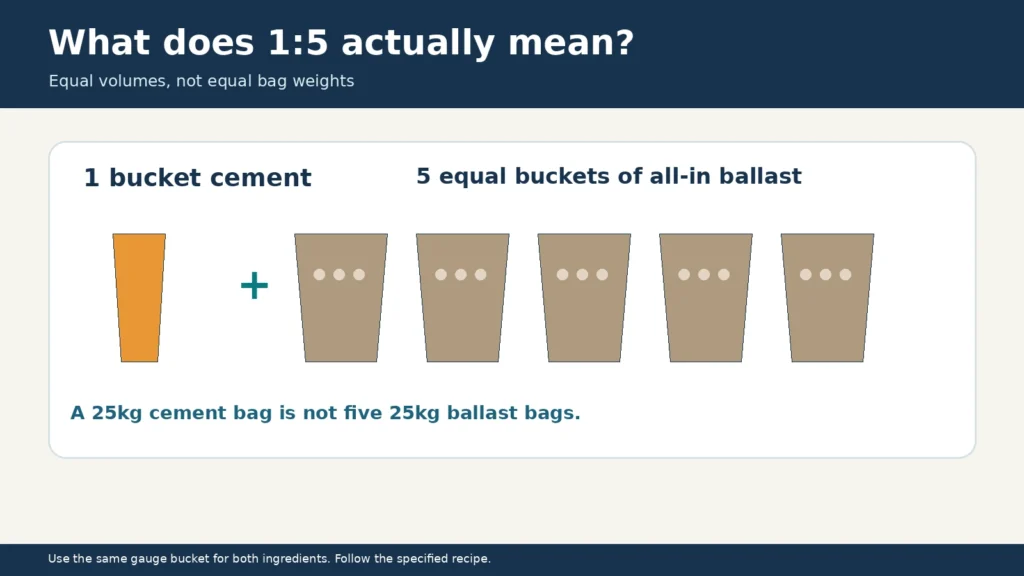
For 1:5 cement to ballast by volume, measure one equal container of cement against five containers of ballast.
Do not assume that means one 25kg cement bag against five 25kg ballast bags. Equal weights do not necessarily occupy equal volumes.
Use a gauge box or the same measuring bucket throughout. Keep each fill consistent. A generous shovel load makes a poor measuring standard.
All-in ballast already contains fine and coarse aggregate, usually sand and gravel. Extra sand changes the mixture unless the recipe specifically requires it.
Why adding separate ingredient volumes can mislead you
Sand can occupy spaces between larger stones. The combined loose volume therefore differs from the separate measured volumes added together.
Likewise, loose ingredients do not automatically produce the same volume of compacted concrete.
That is why a manufacturer can publish different ratios for separate aggregates and blended ballast. Follow the stated alternative instead of inventing an equivalent.
My preference is a published materials table with a clear application. It gives you a firmer starting point than an unexplained universal conversion factor.
I started this comparison looking for one reliable bags-per-cube answer. The conflicting assumptions changed what I wanted the article to explain.
Readers need to understand the inputs before trusting the total. That takes another minute, but it makes a supplier conversation much easier.
For your order, “how much ballast and cement do I need” requires more information than “use five to one”.
Which mix should I use for my project?
Choose the specification before calculating quantities. Strength, exposure, ground conditions and the intended load all matter.
The Cemex Rugby mixing guide separates general concrete, paving and foundation applications.
Its foundation example uses a nominal 1:5 cement to ballast ratio by volume. This guide uses that example for the calculations below. The PDF lacks a clear publication date, so we checked it on 4 October 2026.
These figures illustrate ordering arithmetic. They do not design your footing or establish suitability for your soil.
For structural work, follow the project specification and current product instructions. A nominal ratio alone does not guarantee a tested strength class such as C20/25.
Keep three different materials separate in your notes:
- Cement acts as the binder.
- Ballast supplies the aggregate blend.
- Bagged concrete already contains its dry ingredients.
Your concrete bag calculator may count that third product. It cannot turn those bags into cement-only quantities without another calculation.
Now we can build an order that you can actually check.
How much ballast and cement do I need for a small footing?
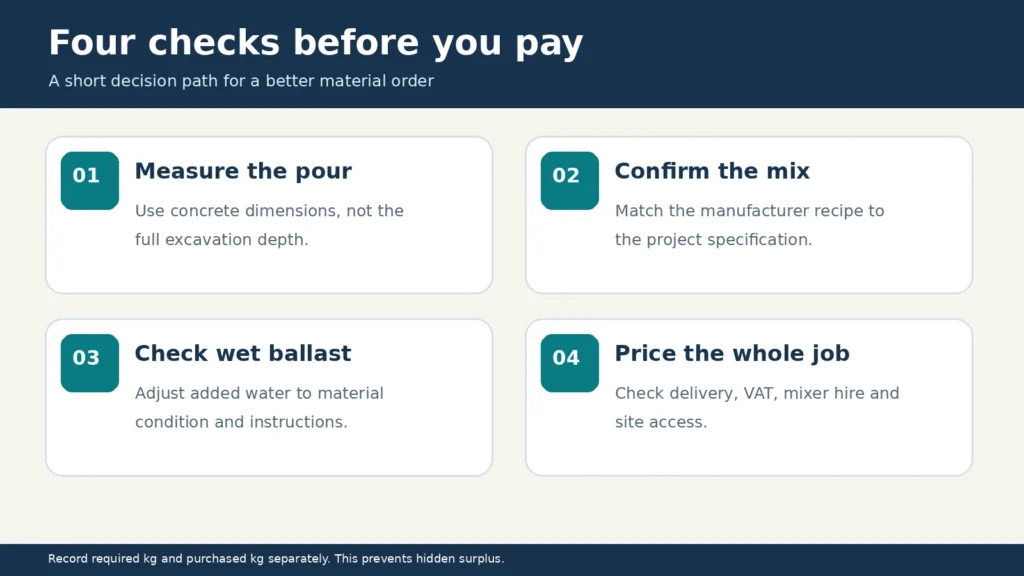
Start with the concrete volume from your confirmed design. Measure the concrete section, rather than automatically using the full excavation depth.
Our concrete calculator helps you check the pour volume. Use its cubic metre result for this ingredient calculation.
Worked example: a 0.45m³ pour
This is an illustrative calculation, not a reported building project or recommended footing size.
Assume a specified concrete section measures 5m long, 0.4m wide and 0.225m thick.
- Calculate volume: 5 × 0.4 × 0.225 = 0.45m³.
- Add an illustrative 5% allowance: 0.45 × 1.05 = 0.4725m³.
- Scale cement: 0.4725 × 265 = 125.2125kg.
- Scale ballast: 0.4725 × 1,800 = 850.5kg.
- Divide cement by 25kg: 125.2125 ÷ 25 = 5.0085 bags.
- Round the cement purchase upward to six bags.
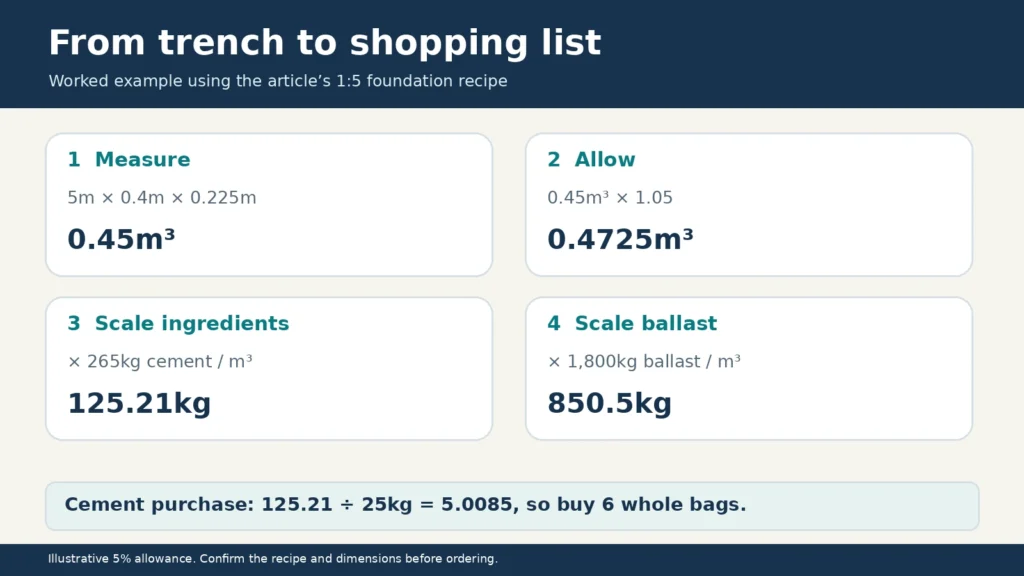
Five bags miss the estimate by only 0.2125kg. That tiny difference illustrates how thresholds affect purchases.
Do not weaken the recipe to force a neater order. Also, do not mistake this precision for perfect knowledge of your trench.
A small width change can outweigh that final decimal place. Recheck the excavation before committing to packs.
For example, another 20mm of width across this section adds 0.0225m³. That equals the entire original 5% allowance.
If the extra width exists, measure it into your base volume. Do not spend the loss allowance twice.
The allowance covers estimated losses. Pack rounding creates a separate surplus, which the next table makes visible.
Reference quantities using the same example recipe
Every row includes the same illustrative 5% allowance. Cement packs weigh 25kg. Ballast figures show material needed before pack rounding.
| Measured concrete | Planned volume | Cement needed | Cement packs | Ballast needed |
|---|---|---|---|---|
| 0.10m³ | 0.105m³ | 27.83kg | 2 | 189kg |
| 0.25m³ | 0.2625m³ | 69.56kg | 3 | 472.5kg |
| 0.45m³ | 0.4725m³ | 125.21kg | 6 | 850.5kg |
| 1.00m³ | 1.05m³ | 278.25kg | 12 | 1,890kg |
Multiply the planned volume by the recipe’s kilograms per cubic metre. Keep full precision until you count purchasable packs.
Change the recipe or allowance and you must recalculate the table.
Should I buy bulk bags or smaller top-up bags?
A “tonne bag” is an informal name. Check the supplier’s declared contents instead of assuming 1,000kg.
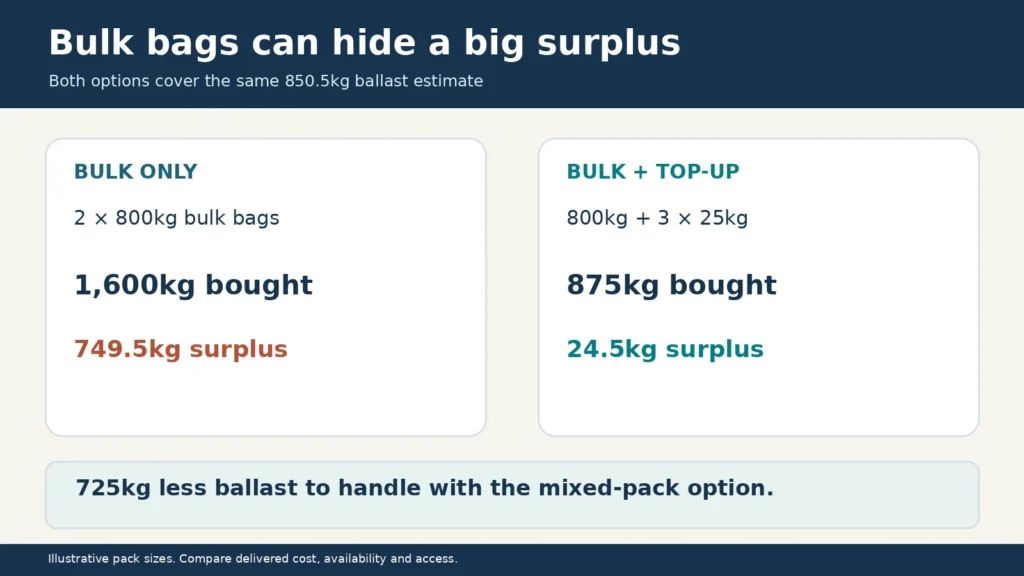
For the 850.5kg example, compare these hypothetical pack combinations:
| Purchase option | Ballast bought | Surplus above estimate | Buying consequence |
|---|---|---|---|
| Two 800kg bulk bags | 1,600kg | 749.5kg | Large unused quantity |
| One 800kg bag plus three 25kg bags | 875kg | 24.5kg | Smaller top-up order |
| One 850kg bag plus one 25kg bag | 875kg | 24.5kg | Check available pack sizes |
| Thirty-five 25kg bags | 875kg | 24.5kg | More individual packs to handle |
This comparison assumes all packs contain suitable, matching ballast. It does not identify the cheapest delivered option.
Research case study two: the rounding penalty
During this calculation, the bulk-only option looked convenient until I checked the leftovers.
Two 800kg bags supplied 725kg more ballast than the 875kg mixed-pack option. Both covered the same calculated requirement.
That is a purchasing result, not a claim about an actual customer’s saving. Your merchant’s delivery charges could still change the best choice.
What if the smaller packs cost more per kilogram?
They can still cost less overall.
Suppose a bulk bag costs £65 and each small pack costs £4. These are invented comparison prices, not current quotes.
Two bulk bags cost £130. One bulk bag plus three small packs costs £77. That leaves £53 for any difference in delivery charges.
When asking “how much ballast and cement do I need”, separate required material from purchased material. Your driveway will thank you.
How much concrete will my existing ballast make?
You can reverse a published ingredient estimate, provided you keep the same recipe assumptions.
For this example, 850kg ÷ 1,800kg per cubic metre gives about 0.472m³ before losses.
The matching cement estimate is about 125.14kg. You would purchase six 25kg bags if you had no usable cement.
That is a planning estimate, not a measured batch yield. Moisture, aggregate grading and your mixing method affect the result.
Do not count hardened cement lumps as usable stock. Check storage condition and the product’s use-by information.
There is another easy shopping mistake here. MOT Type 1 belongs to a different material category from concrete ballast.
If your project includes a separate subbase, calculate its MOT Type 1 quantity separately.
Keep its compacted depth out of your concrete calculation. Otherwise, you could order ingredients for space another material already fills.
What changes when the ballast arrives wet?
Rain changes the water already present in your aggregate. It also changes the relationship between delivered mass and dry material.
Avoid adding a fixed water quantity without checking the recipe and material condition. Follow the manufacturer’s guidance for workable consistency.
Extra water may make a batch easier to move, but it can reduce strength and durability. Cure and protect the placed concrete as directed.
For autumn work, check the forecast before booking materials. Cold weather planning matters more than squeezing the pour into Sunday afternoon.
The HSE’s cement safety guidance explains the risks from skin contact and cement dust. We checked this guidance on 4 October 2026.
Wear suitable waterproof gloves and protective clothing. Keep wet cement out of boots and wash splashes promptly.
Planning safe handling also protects your schedule. Moving hundreds of kilograms through a narrow side passage takes real effort.
Is mixing concrete yourself actually cheaper?
Compare the whole job, including the hours you give up.
Ask merchants and concrete suppliers for quotes covering the same finished quantity and specification. Check VAT, delivery, minimum charges and access requirements.
For site mixing, include mixer hire, collection trips and unused materials. For ready mix, ask about discharge time, waiting charges and placement access.
If you prefer packaged concrete, compare bags using their actual mixed yield. Dry bag weight alone cannot answer that question.
Price headlines also need care. Government statistics published on 16 September 2026 showed contrasting material trends.
The August 2026 construction materials release reported a 3.5% annual fall in July’s cement price index. The wider all-work materials index rose 5.9%.
Those national figures do not predict your local merchant’s quote. They do challenge claims that every building material became dearer.
How much ballast and cement do I need? That decides quantities. Local quotes and workable access decide the sensible buying route.
What else should I check before ordering?