Know Your Garden Wall Footing Concrete Before You Order
You can measure a trench perfectly and still order the wrong amount of concrete. The usual mistake is simple: people multiply the trench’s full depth. Yet concrete may fill only part of it. Another trap hides in the bag count: 20 kg is not 20 litres of finished concrete. So, how much concrete do I need for garden wall footings? Start with the planned pour, not the hole.
Here is the quick answer. Multiply the length, width and actual concrete thickness in metres. Add separate sections and pier pads. Then convert the final cubic metres using the chosen bag’s stated wet yield. Ask a local supplier about delivery access before comparing prices.
This guide handles quantities for a planned footing. It cannot tell you whether that footing is safe for your ground or wall.
How much concrete do I need for garden wall footings?
For a straight, uniform strip footing, use this formula:
Concrete volume in m³ = length in m × width in m × concrete thickness in m
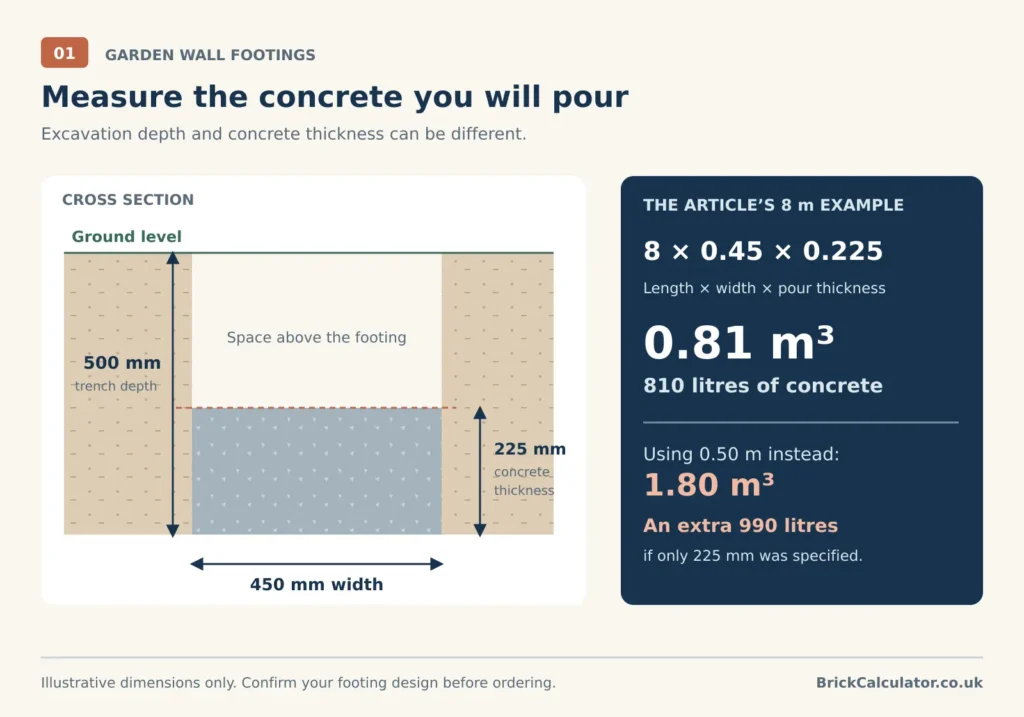
Suppose your proposed strip runs 8 m. Its specified width is 450 mm, and its concrete thickness is 225 mm. Convert millimetres before multiplying:
8 × 0.45 × 0.225 = 0.81 m³, or 810 litres.
That calculation is an order estimate, not a recommended footing size. A designer or competent builder must set the dimensions for your wall, soil and exposure. Avoid copying a number from somebody else’s garden.
I checked a July 2022 BuildHub discussion while researching this question. One homeowner already knew their trench held 4.5 m³. They still needed to know what to buy and how to get it on site. The calculation was easy, but the purchasing decision was hard.
The next distinction saves more concrete than any clever calculator setting.
Is trench depth the same as concrete thickness?
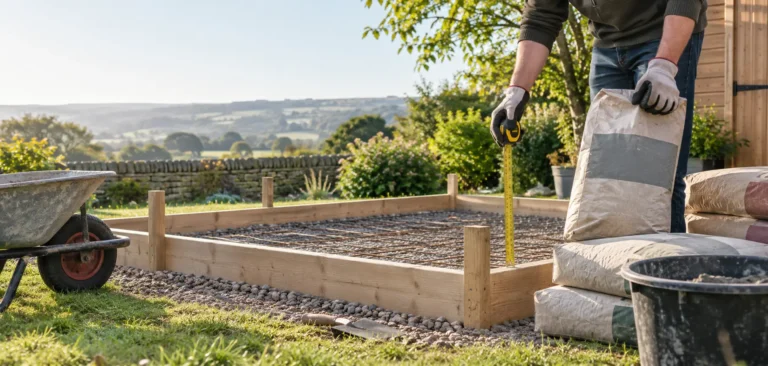
Often, no: excavation depth measures from ground level to the trench bottom. Concrete thickness measures only the depth you intend to pour. You might dig 500 mm down, then pour a 225 mm strip. The remaining space serves the planned construction above it.
Never replace the 225 mm in our example with 500 mm just because the trench reaches that depth. That mistake changes the estimate from 0.81 m³ to 1.80 m³. It adds 0.99 m³ before you order a single bag.
Some designs do fill much more of the trench with concrete. Confirm the actual section on the drawing or with your builder. Mark the intended concrete top along the trench. Measure from that mark to the bottom at several points.
What if the trench changes width or steps downhill?
Split it into rectangles, calculate each segment, then add the results. Do not use one rough average across a sloping garden.
For example, imagine the first 5 m takes a 225 mm pour. The remaining 3 m takes a 300 mm pour. Both sections measure 450 mm wide. These are illustrative dimensions, not design advice.
- First section: 5 × 0.45 × 0.225 = 0.506 m³.
- Second section: 3 × 0.45 × 0.300 = 0.405 m³.
- Combined volume: 0.911 m³ before pads or allowance.
The deeper section adds about 101 litres over the uniform 225 mm example. A single depth entry would hide it. For stepped foundations, check the change in level and section with the person designing the wall.
Do wider pier pads count twice?
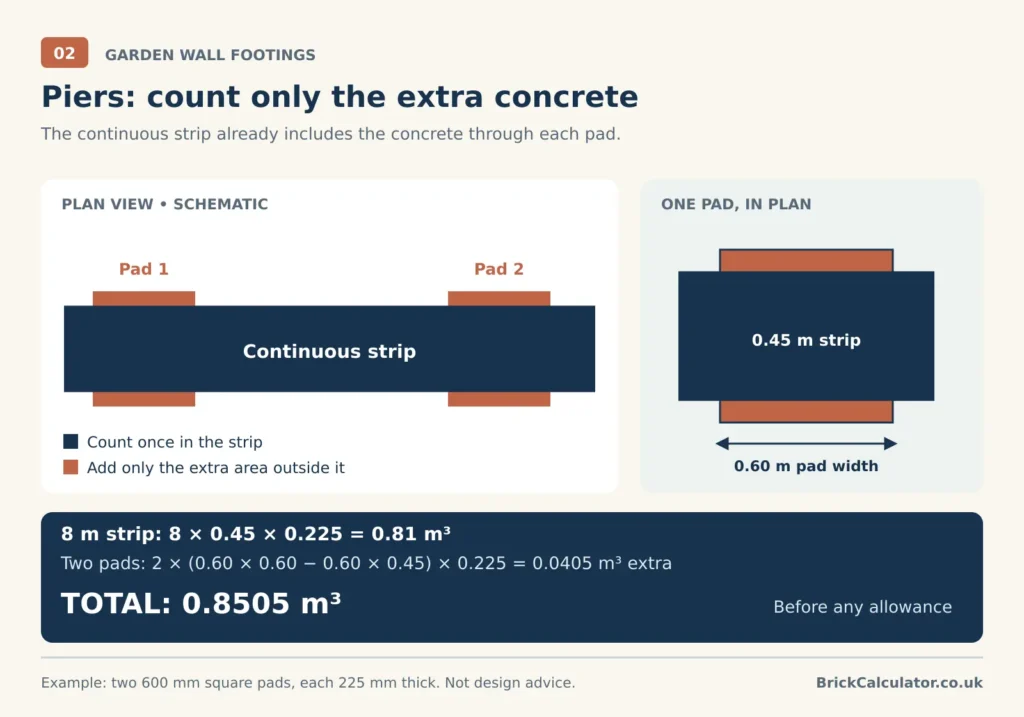
They should not: the strip already occupies the middle of each pad. Add only the extra concrete outside that strip.
Imagine two 600 mm square pads beneath piers along our 8 m strip. Each pad shares its 225 mm thickness. The strip is 450 mm wide. The extra volume per pad equals:
(0.60 × 0.60 − 0.60 × 0.45) × 0.225 = 0.02025 m³.
Two pads add 0.0405 m³, so the revised total becomes 0.8505 m³. This assumes the pads overlap the continuous strip exactly as described. Sketch your layout first, because offset pads and isolated bases need their own measurements.
How much extra should I allow for an uneven trench?
Measure the trench you have, not the trench you hoped to dig. Clay can fall away from a side, and roots can force a local widening. A shovel can turn a neat 450 mm cut into a 480 mm cut. Asking “how much concrete do I need for garden wall footings?” again after digging can save a costly shortage.
Across 8 m, that extra 30 mm needs 8 × 0.03 × 0.225 = 0.054 m³. That is 54 litres. A blanket 5% added to the original 0.81 m³ gives only 40.5 litres. In this case, the fashionable percentage would leave you short.
This changed how I frame the usual “add 10%” advice. First, measure real changes, then discuss an allowance for unavoidable loss with your supplier or builder. A percentage cannot repair bad dimensions.
A five-minute trench check before placing an order
- Mark each change in width, depth, level or footing type.
- Record dimensions in millimetres at the start, middle and end of each section.
- Confirm the concrete top level, not just the excavation depth.
- Calculate each rectangle and any extra pad volume.
- Add measured overdig and a clearly stated allowance once.
- Write down the final m³ figure and the assumptions beside it.
Use the UK concrete calculator for a second volume check. Choose its strip foundation option and compare the output with your section worksheet. If they differ, check your units and pads before spending money.
How many bags of concrete does a garden wall footing take?
Divide the required litres by the chosen product’s wet yield per bag. Round up to a whole bag, and never convert kilograms directly into litres. Cement powder, ballast and premixed concrete are different purchases. The question “how much concrete do I need for garden wall footings?” now becomes a product-specific bag calculation.
Tarmac’s High Strength Concrete product sheet says its 20 kg bag produces about 10 litres of fresh concrete. That is 0.01 m³ for this specific product. Its strength rating does not automatically make it the right specification for your footing.
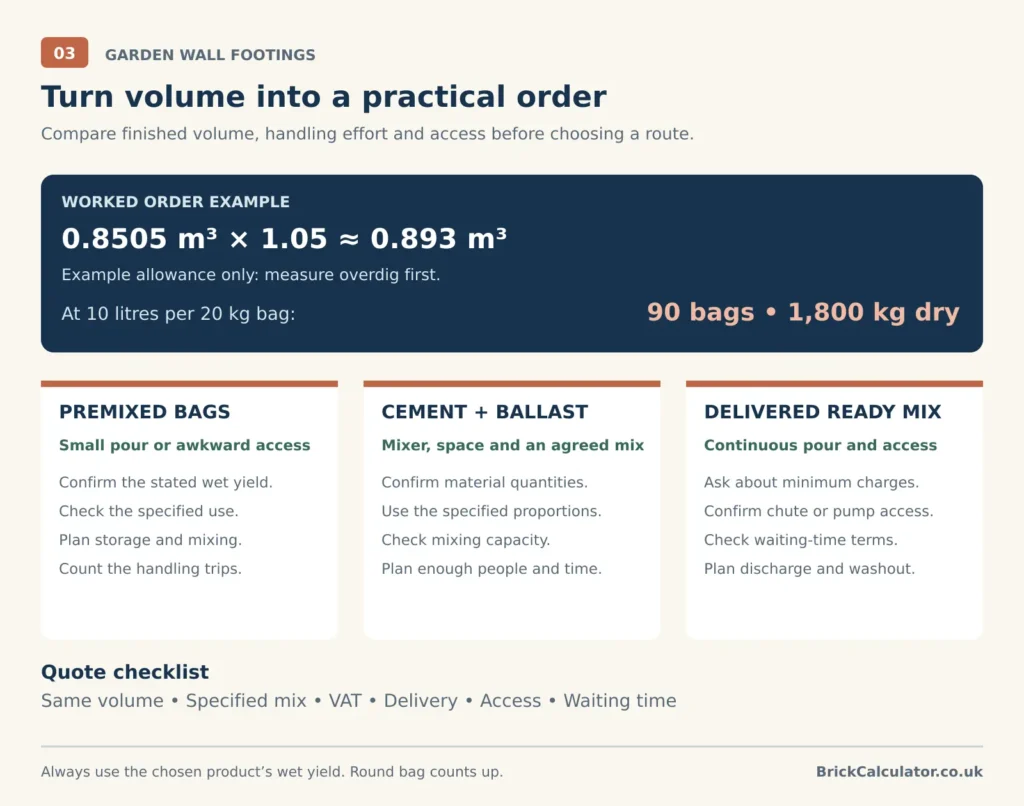
Using that yield, the original 0.81 m³ strip needs 81 bags. With the two pier pads, 0.8505 m³ needs 86 bags after rounding up. If an agreed 5% allowance applies to that revised figure, the target reaches 0.893 m³, or 90 bags.
At 20 kg each, 90 bags weigh 1,800 kg before water. That number changes the conversation: where will the bags sit? How many journeys cross the lawn, and who will mix and place them in time?
If your supplier sells a 25 kg bag, find its own stated yield. A larger bag does not always scale neatly from a different formula. Check the technical sheet, batch instructions and suitability for the specified work. The general concrete buying guide explains bag labels in more detail.
Should I buy bags, mix ingredients, or order ready mix?
There is no magic cubic-metre cutoff: access, labour, delivery and pour timing matter as much as shelf price. Use the same finished volume when comparing all three routes.
| Route | Usually useful when | Ask before buying |
|---|---|---|
| Premixed bags | Small pour, awkward access, easy storage | What is the wet yield and suitable use? |
| Cement and ballast | You have a mixer, space and an agreed mix specification | What are the actual material quantities and mixing capacity? |
| Delivered ready mix | Larger continuous pour and workable vehicle access | What are the minimum load, part-load charge and discharge terms? |
Those are decision prompts, not fixed price rankings. A merchant may quote cheap bags, then charge for delivery. A ready-mix supplier may have a minimum invoice even when your trench takes less than a cubic metre. A volumetric truck can sometimes supply the amount mixed on site. Ask what service actually reaches your address.
For a realistic comparison, request written quotes for the same 0.893 m³ target. Include VAT, delivery, part-load fees, waiting time and any pump or barrow service. Ask what happens if the trench takes more or less. “How much concrete do I need for garden wall footings?” matters less if the truck cannot reach them. A 2026 UK price copied from another postcode will not answer those questions.
The UK government’s September 2026 materials update reported a 5.9% annual rise in its all-work materials index for July. That is not a concrete price increase for your garden. It is one more reason to date your quotes.
What if the garden has no vehicle access?
This is where the spreadsheet meets the back door. An October 2021 DIYnot user had access only through the house. Bagged concrete seemed expensive, but a delivery lorry could not simply reach the trench.
Before ordering, walk the route with a tape measure. Check gate width, steps, turns, parked cars and a safe place for washout. Count wheelbarrow trips if a supplier plans to discharge at the kerb. Ask whether the mix can be placed within the supplier’s allowed time. Never assume a truck will wait while you solve an access problem.
For our 0.893 m³ illustration, roughly 893 litres must reach the footing. That is many small barrow loads. For the forum’s 4.5 m³ case, the same 10-litre bag yield would imply 450 bags and nine tonnes of dry bags. That is arithmetic, not a purchase recommendation. The access plan and specified mix decide the practical route.
When does a garden wall need a footing design, not just a calculator?
A quantity tool cannot judge soil bearing, wind load or a retaining wall. The government’s garden wall safety guidance, published in May 2013, excludes piers, heavy gates and retained soil. Seek competent advice for those situations.
Also flag nearby trees, disturbed ground, drains, sloping sites, unusually tall walls and a wall beside a public path. Chalk, clay and made ground can behave differently. A foundation copied from a photo may waste concrete and still fail.
Before digging, check for buried services and keep excavation sides safe. Wet cement can burn skin, as the UK Health and Safety Executive warns. Wear suitable protection and wash contamination away promptly.
I would rather see a homeowner pause for a design check. Extra concrete cannot replace one. Strength, thickness and reinforcement relate to the wall’s job. More concrete does not fix a retaining wall with the wrong drainage or geometry.
What should I check before the concrete arrives?
- Confirm the wall type and approved footing dimensions.
- Recheck every section’s length, width and actual pour thickness.
- Mark pier pads, changes in level and measured overdig.
- Agree on the concrete specification with the builder or designer.
- Compare bag yield or obtain a dated ready-mix quote.
- Check vehicle access, discharge point, labour and weather forecast.
- Prepare tools, protection and a plan for small surplus amounts.
Then calculate the final order once and keep the worksheet with your receipts. That small paper trail makes a missing bag or unexpected short load easier to explain.
Frequently Asked Questions (FAQ’s)?
The final number should be boring. You should be able to trace every litre back to a measured section. Then “how much concrete do I need for garden wall footings?” has an answer you can defend. That is how you avoid both the half-finished pour and the pile of unused bags. Next, estimate bricks and mortar for the wall above, using the same measured length.