UK Aggregate & Tonnage Calculator
Estimate aggregate volume, tonnes, bulk bags, small bags and material cost for UK projects. Results are planning estimates; use your supplier’s stated density and bag weight whenever available.
The calculator inserts a typical planning density. Replace it with the bulk density stated by your quarry or builders' merchant for a more accurate estimate.
Enter a valid density greater than zero.
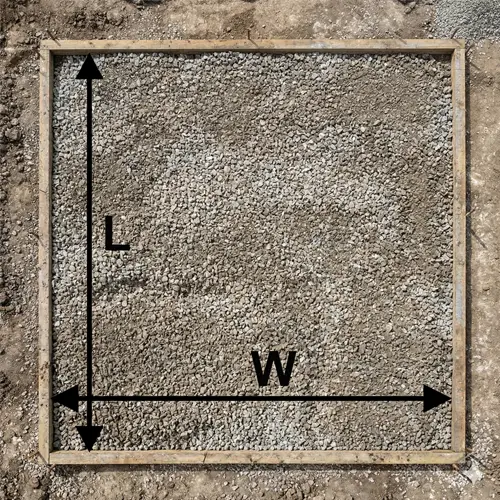
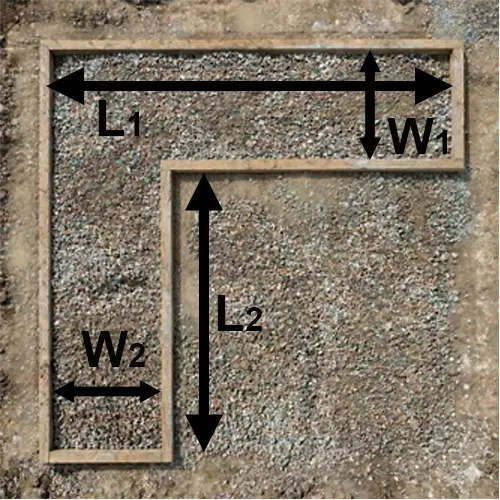
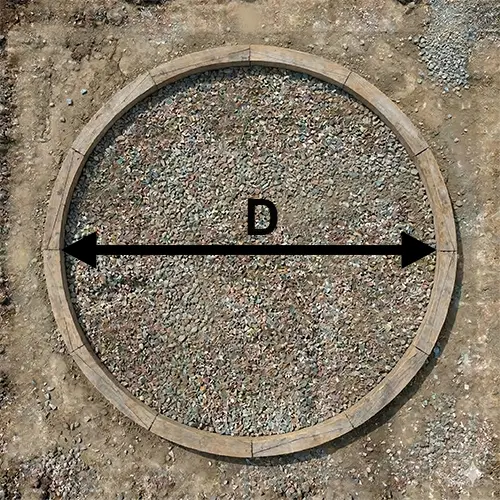
Enter a measurement greater than zero.
Enter a measurement greater than zero.
Enter a measurement greater than zero.
Enter a measurement greater than zero.
Enter a measurement greater than zero.
Enter a depth greater than zero.
This uplift covers normal variation, spillage and compaction. Set it to 0 if your supplier or specification already includes an allowance.
Allowance cannot be negative.
Enter a bag weight greater than zero.
Enter a bag weight greater than zero.
Delivery, minimum-order and access charges are not included.
Enter a cost greater than zero.
Estimated aggregate requirements
-
Check the supplier's product density, moisture condition and actual bag weight before ordering. For structural or adopted-highway work, use the project specification and professional design rather than a general online estimate.
How much aggregate do I need?
To estimate how much aggregate you need, calculate the area, multiply it by the finished layer depth to get cubic metres, then multiply the volume by the material’s bulk density. Add a sensible ordering allowance and divide the final weight by the actual bag weight if you are buying bulk bags or small bags.
The calculator above does this for rectangles, circles and L-shaped areas. It can estimate MOT Type 1, gravel, sand, ballast, crushed concrete, slate, limestone scalpings and other common UK materials. Because density and bag weights vary by supplier, check the product specification before ordering.
Aggregate calculator formula
For a rectangular area:
Volume (m³) = length (m) × width (m) × depth (m)
Calculated tonnes = volume (m³) × bulk density (t/m³)
Order tonnes = calculated tonnes × (1 + ordering allowance ÷ 100)
Number of bags = order tonnes × 1,000 ÷ bag weight in kg, rounded up to the next whole bag
For a circular area, calculate the area as π × radius², then multiply by depth. For an L-shape, split the area into two non-overlapping rectangles, calculate each rectangle and add the two volumes.
Quick worked example
A driveway sub-base is 6 m long, 4 m wide and 100 mm deep. Convert 100 mm to 0.10 m:
Volume = 6 × 4 × 0.10 = 2.40 m³
Using a planning density of 2.0 t/m³: 2.40 × 2.0 = 4.80 tonnes
With a 10% ordering allowance: 4.80 × 1.10 = 5.28 tonnes
That is 7 bulk bags at 850 kg each, or 212 small bags at 25 kg each. Confirm the actual bag weight and density with the supplier before ordering.
How to use the UK aggregate calculator
1. Choose the shape
Select rectangle/square, circle or L-shape. For an L-shape, divide the project into two rectangles that do not overlap.
2. Choose metric or imperial units
Metric is the normal choice for UK construction. The calculator also supports feet, inches and yards.
3. Select the material
Choose the closest aggregate or landscaping material from the list.
4. Check the density
The calculator inserts a typical planning density for the selected material. Replace it with the bulk density supplied by your quarry or builders’ merchant when available.
5. Enter the dimensions and depth
Measure the actual area and enter the compacted or finished layer depth required by the project.
6. Set the ordering allowance and bag weights
The default allowance is 10%, but it can be changed. Select the actual 800 kg, 850 kg, 1,000 kg, 20 kg or 25 kg bag size offered by the supplier.
7. Add an optional cost per tonne
The material cost estimate excludes delivery, minimum-order, access, crane, grab and collection charges.
8. Calculate and verify
Use the result as a planning quantity, then confirm the product specification and order size with the supplier.
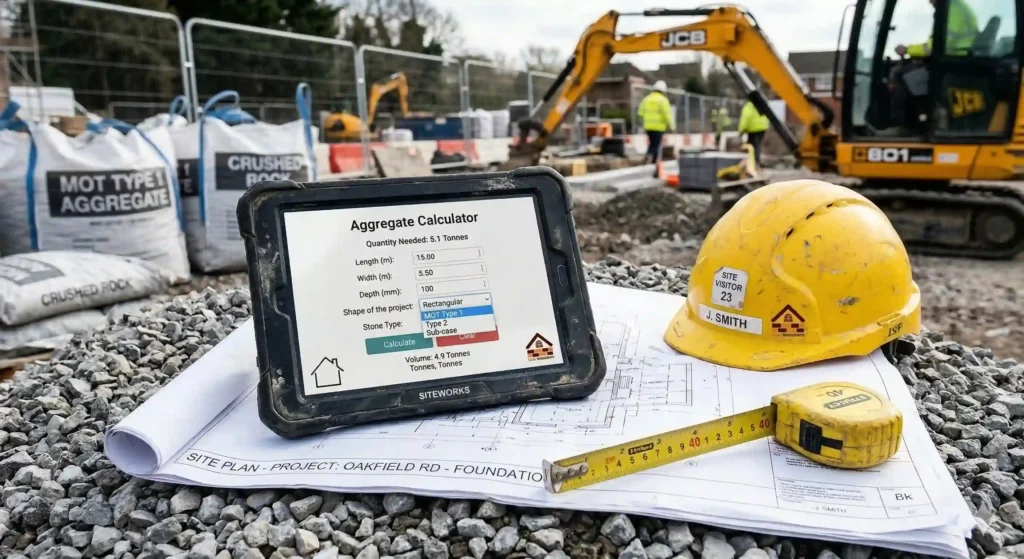
Typical aggregate densities used by this calculator
Bulk density is the estimated weight of loose material in a known volume, including the spaces between particles. It is not the same as the particle density of the stone itself. Moisture, grading, quarry source and compaction can change the real figure, so the values below are planning assumptions rather than universal specifications.
| Material | Default Planning Density |
|---|---|
| MOT Type 1 / Clause 803 Type 1 | 2.00 t/m³ |
| MOT Type 3 | 1.80 t/m³ |
| Recycled Type 1 | 1.85 t/m³ |
| 6F2 / 6F5 crushed concrete | 1.85 t/m³ |
| Type 2 sub-base | 2.00 t/m³ |
| Road planings | 1.90 t/m³ |
| Sharp sand / grit sand | 1.60 t/m³ |
| Building sand | 1.50 t/m³ |
| Kiln-dried jointing sand | 1.50 t/m³ |
| 10 mm pea shingle | 1.60 t/m³ |
| 20 mm gravel / shingle | 1.70 t/m³ |
| 40 mm slate chippings | 1.40 t/m³ |
| Gabion stone | 1.60 t/m³ |
| Self-binding gravel | 2.00 t/m³ |
| Cotswold buff / stone | 1.40 t/m³ |
| Scottish pebbles / cobbles | 1.60 t/m³ |
| 20 mm all-in ballast | 1.90 t/m³ |
| Limestone scalpings | 2.10 t/m³ |
| Granite dust / grano dust | 2.00 t/m³ |
| Cold-lay macadam | 2.20 t/m³ |
| Standard topsoil | 1.40 t/m³ |
| Screened topsoil | 1.20 t/m³ |
| Bark chippings / play mulch | 0.25 t/m³ |
Use the supplier’s declared bulk density whenever it is available. If the product is sold only by bag coverage rather than density, compare the supplier’s stated coverage with the calculator result before buying.
Bulk bags, tonne bags and small bags
A bulk bag is not automatically one tonne. UK merchants commonly sell aggregate in bags described as approximately 800 kg, 850 kg or 1,000 kg, while smaller sealed bags are often 20 kg or 25 kg. The bag name, fill weight and product moisture can differ, so use the weight printed on the product page or delivery note.
The calculator rounds bag quantities up because suppliers do not sell part of a bag. For larger jobs, compare bulk-bag pricing with a loose tipped load. A loose load can be more economical per tonne, but access, delivery vehicle size, minimum order, storage space and unloading method may make bags more practical.
How much area does one 850 kg bulk bag cover?
Coverage depends on both density and depth. Use this formula:
Coverage area (m²) = bag weight (tonnes) ÷ density (t/m³) ÷ depth (m)
Example 1: 850 kg of gravel at 1.7 t/m³ provides about 0.50 m³. At a 50 mm depth, it covers about 10 m².
Example 2: 850 kg of MOT Type 1 at 2.0 t/m³ provides about 0.425 m³. At a 100 mm depth, it covers about 4.25 m².
These examples are estimates. Use the supplier’s product density and advertised coverage where available.
Common planning depths for UK projects
The depth entered in the calculator has a direct effect on the result. The ranges below are common planning starting points for domestic work, not a substitute for a pavement design, building specification or site assessment. Ground strength, drainage, loading, edge restraint, material grading and the number of compacted layers can change the required construction.
| Project / Layer | Planning Range | Important Note |
|---|---|---|
| MOT Type 1 under a domestic driveway | Often 100–150 mm compacted | Heavier vehicles, weak ground or poor drainage may require a designed build-up. |
| MOT Type 1 under a patio or path | Often 75–100 mm compacted | Use the paving manufacturer’s installation guidance and assess the subgrade. |
| Shed or garden-building base | Often 75–100 mm compacted | The building weight and foundation system may require a different design. |
| Decorative gravel driveway | Often 40–50 mm surface layer | Too much loose decorative gravel can rut and move under tyres. |
| Decorative path or border | Often 30–50 mm | Particle size, membrane and edging affect the final depth. |
| Sharp-sand bedding for block paving | Often 30–50 mm before final compaction | Follow the paving-system specification; do not use building sand as a substitute. |
| Drainage or structural fill | Project-specific | Use the drawing or specification and a suitable graded aggregate. |
For adopted highways, commercial pavements or structural work, use the specified material and construction depth. Type 1 and Type 3 are defined unbound mixtures, but the required foundation thickness is determined by the project design and ground conditions.
Worked aggregate calculator examples
Example 1: MOT Type 1 for a rectangular driveway
Area: 6 m × 4 m = 24 m²
Depth: 100 mm = 0.10 m
Volume: 24 × 0.10 = 2.40 m³
Density used: 2.0 t/m³
Calculated weight: 2.40 × 2.0 = 4.80 tonnes
With 10% allowance: 5.28 tonnes
Order estimate: 7 × 850 kg bulk bags, 6 × 1,000 kg bags, 264 × 20 kg bags or 212 × 25 kg bags.
Example 2: gravel for a circular area
Diameter: 4 m, so the radius is 2 m
Area: π × 2² = 12.57 m²
Depth: 50 mm = 0.05 m
Volume: 12.57 × 0.05 = 0.628 m³
Density used: 1.7 t/m³
Calculated weight: 1.068 tonnes
With 10% allowance: 1.175 tonnes
Order estimate: 2 × 850 kg bulk bags or 59 × 20 kg bags.
Example 3: sharp sand for an L-shaped area
Rectangle 1: 5 m × 2 m = 10 m²
Rectangle 2: 3 m × 2 m = 6 m²
Total area: 16 m²
Depth: 75 mm = 0.075 m
Volume: 16 × 0.075 = 1.20 m³
Density used: 1.6 t/m³
Calculated weight: 1.92 tonnes
With 5% allowance: 2.016 tonnes
Order estimate: 3 × 850 kg bulk bags or 81 × 25 kg bags.
Choosing the right aggregate
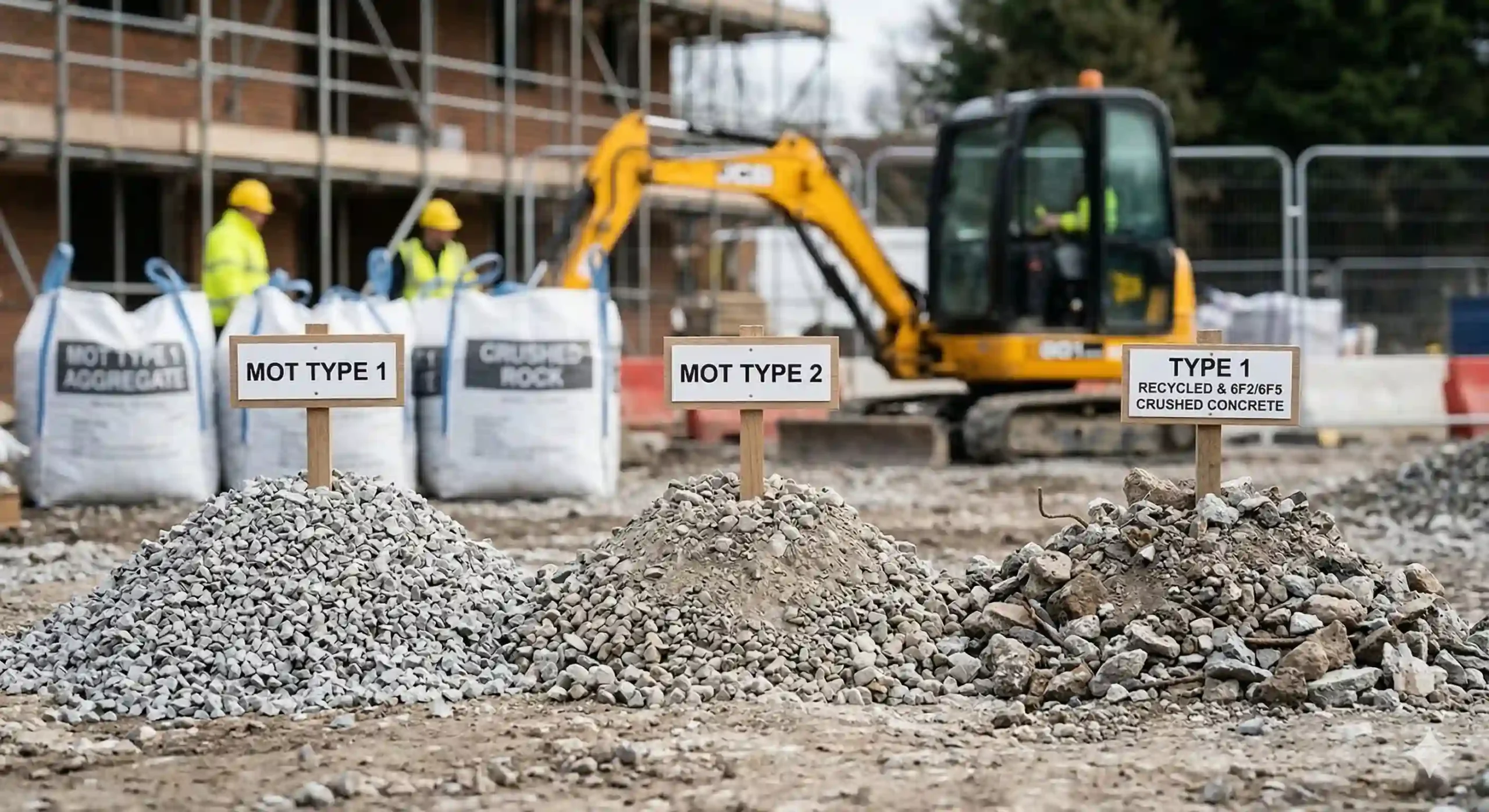
MOT Type 1 and Type 3
MOT Type 1 is a dense, well-graded sub-base material commonly used beneath non-permeable driveways, paths and paving. Type 3 contains fewer fines and is used where a more open, permeable sub-base is required. For specified work, order material that complies with the required clause or standard rather than relying only on a merchant’s product name.
Recycled Type 1 and 6F2/6F5
Recycled Type 1 can be suitable for many sub-base applications when it meets the required specification. 6F2 and 6F5 are coarser recycled or crushed materials often used for capping, deep fill and formation work. They are not automatically interchangeable with a finished Type 1 sub-base.
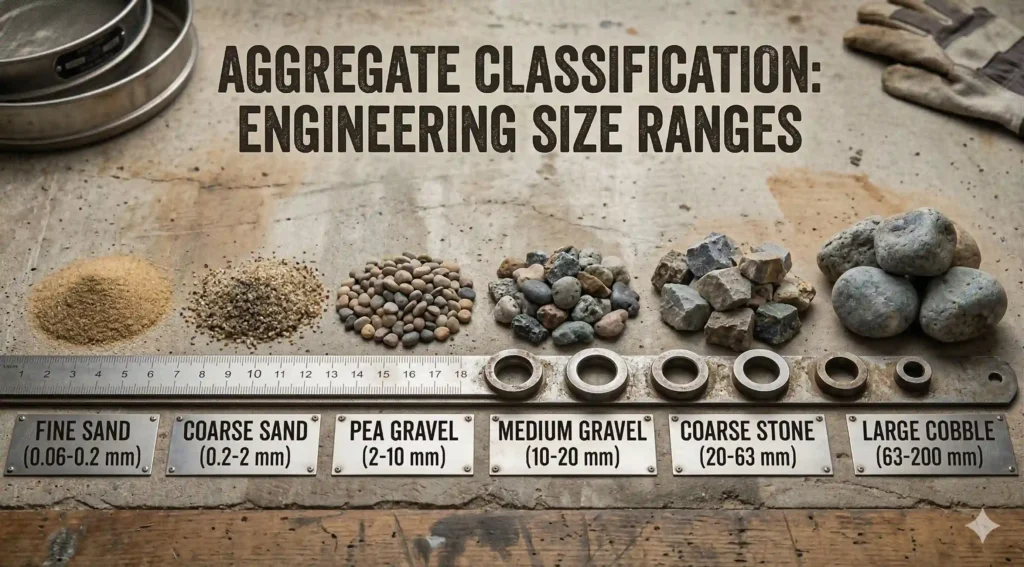
Sharp sand, building sand and kiln-dried sand
Sharp sand is coarse and is used for screeds, paving and some concrete applications. Building sand is finer and is normally used for bricklaying mortar. Kiln-dried sand is a dry jointing sand for block paving. Select the product required by the construction method; do not substitute one sand because the names sound similar.
Gravel, shingle and slate
Decorative gravel and slate are usually selected by particle size, appearance and intended use. A 20 mm angular or rounded gravel is commonly chosen for driveways, while smaller gravel can suit paths and borders. Slate chippings are flatter and may use a lower planning density than dense crushed stone.
Ballast
All-in ballast is a graded mixture of sand and gravel commonly combined with cement and water to make concrete. It is different from decorative gravel and from a compacted Type 1 sub-base. Use a concrete calculator and the specified mix or supplier product when estimating concrete.
Limestone scalpings and granite dust
Limestone scalpings are crushed limestone with fines and can be used for sub-base, fill or temporary surfaces where suitable. Granite dust or grano dust is a fine crushed material used for bedding, screeds and specialist surfaces. Confirm grading and suitability with the supplier.
Road planings and cold-lay macadam
Road planings are reclaimed asphalt material and may be used for tracks, temporary surfaces or fill where permitted. Cold-lay macadam is a bagged or bulk repair material, not a direct substitute for loose aggregate. Product density and intended use vary widely.
Topsoil and bark
Topsoil and bark are included for landscaping convenience, but they are not mineral construction aggregates. Their moisture content and degree of screening can cause large density variation, so supplier volume or coverage information may be more useful than a generic weight conversion.
Estimating aggregate cost
Enter the supplier’s current price per tonne to estimate the material cost. The result covers the material only. It does not include delivery, minimum-order charges, restricted-access delivery, crane or grab unloading, waiting time, collection, disposal of surplus material or VAT unless those costs are already included in the entered price.
When comparing quotes, convert every option to the same basis. An 850 kg bulk bag should not be compared directly with a loose-tonne price without adjusting for weight. Check the stated weight, whether the price includes VAT and whether delivery to your postcode is included.
Why aggregate estimates can differ
Two calculators can return different tonnage for the same area because they may use different bulk densities, allowances or bag weights. Real material can also be wetter, drier, more open-graded or more compacted than the assumed value.
For the best estimate: measure the area carefully, use the correct finished depth, enter the supplier’s density, select the actual bag weight, and add only the allowance that is appropriate for the job. For specified construction, follow the drawing and material schedule.
Frequently Asked Questions
How this calculator is reviewed
This calculator uses transparent volume, density, allowance and bag-weight formulas. The default densities are planning assumptions for common UK materials and can be edited to match a supplier’s product data.
For structural, commercial or adopted-highway construction, use the project drawings, specification and professional advice.
More Free Tools You Might Find Helpful




How Much Is Tarmac Per Square Metre in the UK? Driveway Cost Calculator Guide
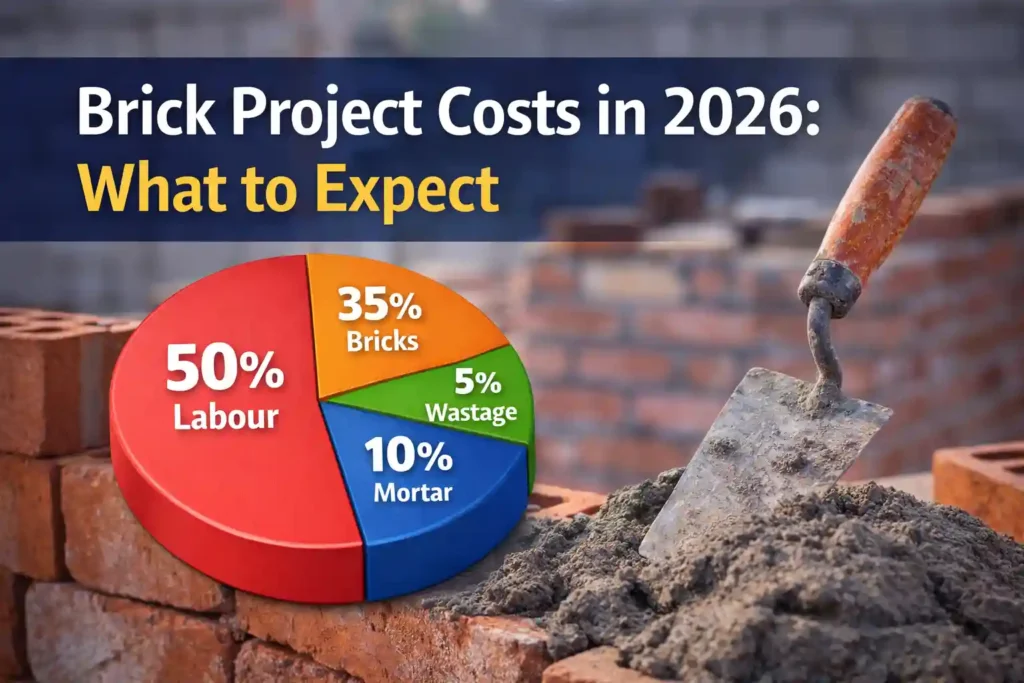
It’s 8:20 on a wet Tuesday morning in Birmingham. A homeowner has two driveway quotes sitting on the kitchen table…Bricklaying Costs 2026: The Complete Price Guide for Materials & Labour
Introduction: The 2026 Price Landscape After a rough few years on the tools, things have finally calmed down a bit…The Ultimate UK Guide to Spalling Bricks and How to Fix Them
The Ugly Truth About Blown Bricks There is one sight that makes almost every UK homeowner panic. You walk out…