Why Do My New Floor Tiles Sound Hollow? Check Before You Repair

Tap a new tile and hear a low, drum-like “tok”? It is unsettling, especially when the grout still looks perfect. But sound alone cannot tell you whether a tile has failed.
A hollow note may come from a small void beneath the tile, a membrane, a local change in the substrate, or even the room’s acoustics. A loose tile often adds movement, cracked grout, or a changing sound. Those clues matter more than one tap.
Here is the sensible order: map the sound, check for movement and damage, then ask the installer to inspect any new work. Do not start by drilling or injecting adhesive. A quick repair can hide a larger failure.
One distinction will save you time: a tile that sounds different is not automatically detached. The next checks help separate an odd acoustic spot from a repair problem. Hollow tiles often start with too little adhesive. Our free tile adhesive calculator shows how much you need for your trowel notch.
Do hollow-sounding tiles always mean a problem?
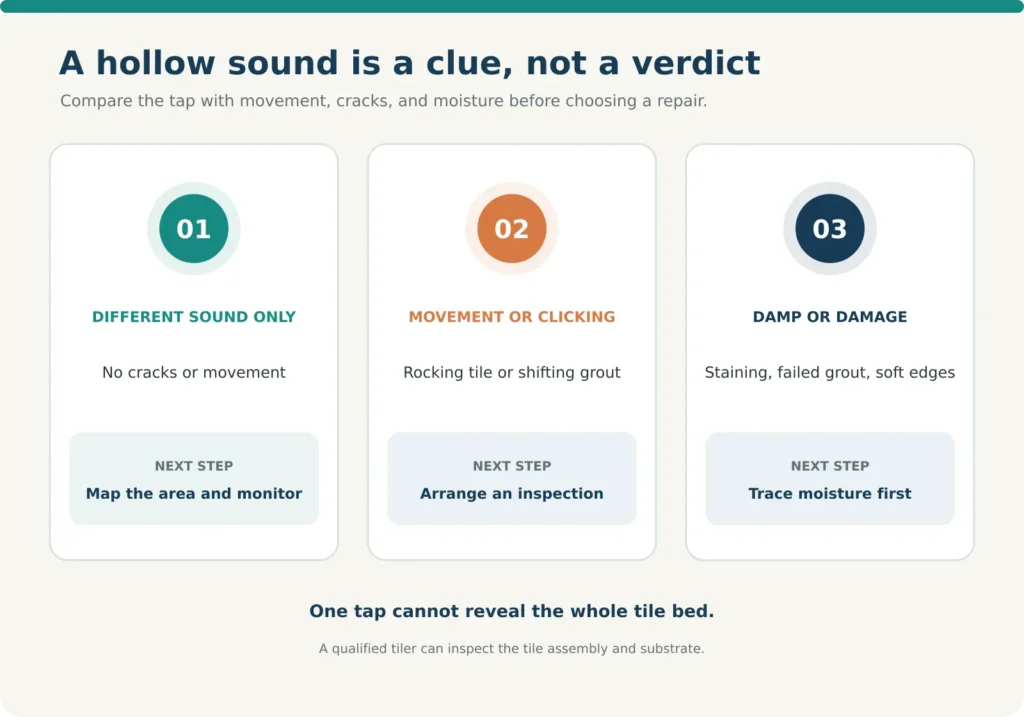
No. A hollow sound is a clue, not a verdict. A firmly bonded tile can sound different from its neighbours because adhesive coverage, the substrate, or an uncoupling mat changes how sound travels. Tap the same tile in several places and compare it with similar tiles nearby.
Concern rises when the sound comes with movement underfoot, a rocking edge, cracked grout, a hairline tile crack, or a gap at the skirting. A spreading hollow area also deserves prompt inspection. In a shower or other wet area, damaged grout or failed seals raise the stakes because water can reach the tile bed.
British Standards’ BS 5385 series covers the design and installation of wall and floor tiling. It sets out installation practice, but a tap test by itself does not establish a standards breach. The Tile Association’s tiling guidance helps explain good practice for homeowners. Ask a qualified tiler to assess the actual installation.
My strong view: do not let a single “hollow” label decide whether an installer must replace a floor. Document patterns and symptoms first. That makes a fair discussion far easier.
What causes new floor tiles to sound hollow?
A gap or uneven adhesive contact
Tiles need suitable adhesive contact across the back. Ridges that remain partly uncollapsed can leave channels or pockets. Large porcelain tiles, an uneven floor, and poor back-buttering technique can make full contact harder. A trowel notch alone does not guarantee coverage.
Standards and adhesive makers set coverage expectations for different locations and products. Wet rooms and external areas need especially careful installation. The precise method depends on the tile, substrate, adhesive, and manufacturer instructions. If the installer kept a first-tile lift check or site photos, ask to see them.
Movement in the floor below
A tile bed can only perform as well as the surface beneath it. A flexible timber floor, loose floorboards, an inadequately fixed backer board, or a moving screed can stress the bond. Movement may show up as repeated cracks along grout lines or a hollow note that grows over time.
An uncoupling membrane can help manage certain kinds of movement when correctly specified and installed. It cannot make a weak or unstable floor sound. The installer should check the build-up, not just the tile surface.
Moisture or a wet-area failure
A leak can weaken materials or damage the substrate, though a hollow sound does not prove water is present. Look for persistent damp, mould, staining, soft skirting, or grout that keeps failing. In a bathroom, check seals and plumbing before treating the sound as an isolated tile issue.
If moisture is suspected, stop guessing. A plumber or building professional can trace the source before anyone lifts tiles. Replacing the tile while a leak continues simply resets the clock.
Underfloor heating or a membrane
Underfloor heating creates temperature cycles. Correct movement joints, compatible adhesive, and a suitable commissioning process help the tiled assembly cope. A membrane can also change the sound when tapped. That does not automatically mean the membrane or tile has failed.
In September 2026, adhesive and system makers continued to promote products designed for particular substrates and heating systems. Product claims are not a substitute for matching the full system. Check the current data sheet and installation instructions for the exact adhesive, primer, membrane, and heating setup.
The sound pattern can point you toward the cause, but the same sound may have different explanations. Use the checks below before choosing a repair.
How can I check whether a tile is loose?
Use a repeatable check, not a hammer. A metal object can damage a glazed edge and produces inconsistent results. A knuckle or plastic handle is enough for a basic comparison.
- Photograph the floor in daylight. Mark the tiles that sound different on a simple sketch.
- Tap gently at the centre, then near each corner. Compare matching spots on neighbouring tiles.
- Press the tile with your foot. Watch the grout line and listen for a click or shift.
- Inspect grout, tile edges, thresholds, skirting, and nearby sealant for cracks or gaps.
- Repeat the check after a few days. Note whether the sound or movement changes.
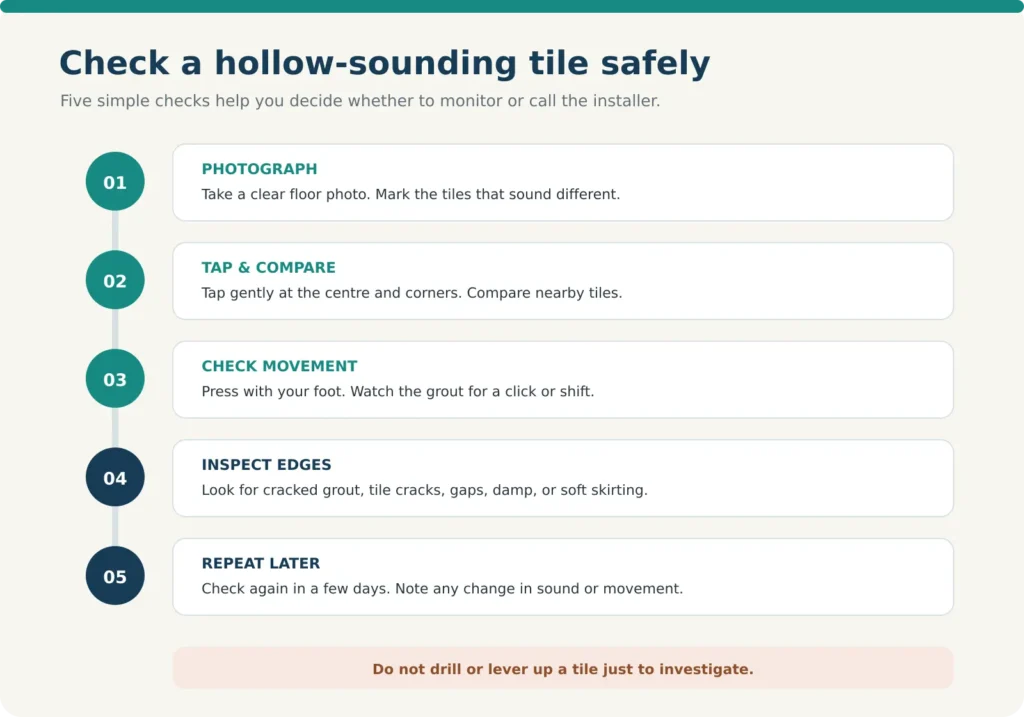
Do not lever up a tile just to investigate. You could chip it, damage a heating cable, or affect a waterproofing layer. If the floor is newly installed, contact the contractor before any invasive test.
| What you notice | What it may suggest | What to do |
|---|---|---|
| Different sound, no movement or cracks | A local change in contact or floor build-up | Map it and monitor. Ask installer if newly fitted. |
| Rocking, clicking, or movement | Possible loss of bond or unstable substrate | Stop stressing the tile and arrange an inspection. |
| Cracked grout or tile with a hollow area | Movement, impact, or bond failure may be present | Photograph it and request a cause assessment. |
| Damp signs or repeated grout failure | Moisture or a wet-area detail may need attention | Trace water source before replacing tiles. |
This table helps you decide what to do next. It cannot diagnose a hidden adhesive bed from sound alone.
What do real examples tell us?
Homeowner discussions show why “just inject it” is too confident. In a 2026 DIYUK thread, a homeowner reported that five tiles lifted after grout was cleared. That is a useful warning about movement and bond loss, but it is one person’s account. It does not establish a universal cause or prove the repair method.
A January 2026 YouTube demonstration showed epoxy injection followed by a retap. The creator reported a changed sound. That may be useful as a case example, but a video cannot verify long-term bond strength, moisture condition, or whether the injection reached every void.
The TileLetter article on hollow-sounding tiles discusses why acoustic checks can be misleading. I used to think the tap test was the whole diagnosis. It is not. The useful question is whether the sound matches visible damage, movement, or a known floor-system issue.
Treat online repairs as anecdotes. Ask what the tile assembly was, what product was used, and whether the repair lasted. Those details rarely fit into a short video.
Which repair should I choose?
Match the repair to the cause. There is no reliable one-size-fits-all fix for a hollow note.
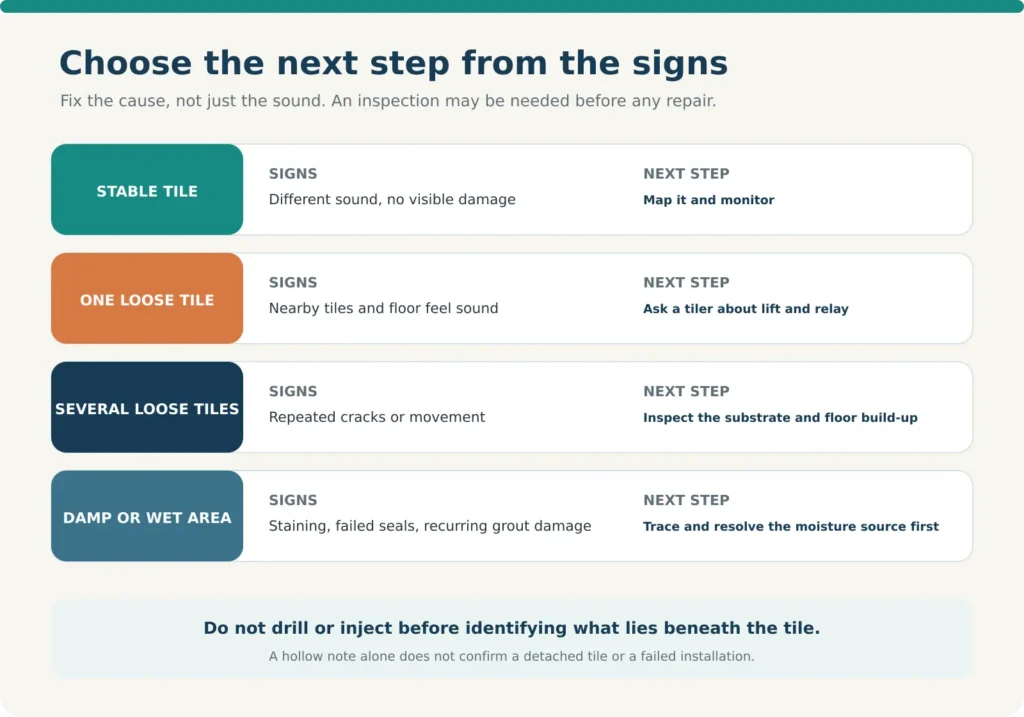
| Situation | Possible next step | Main limitation |
|---|---|---|
| Sound differs, tile stable, no damage | Monitor and record changes | Monitoring does not explain the original sound. |
| One confirmed loose tile, surrounding floor sound | Careful lift and relay by a tiler | Tile may break during removal. Matching batch can be hard. |
| Several tiles move or cracks repeat | Assess substrate, joints, and floor build-up | A surface-only patch may fail again. |
| Suspected moisture or heating issue | Trace and resolve source before relaying | May require plumbing or specialist checks. |
When injection adhesive might be considered
Some systems inject resin or adhesive beneath a tile. They may suit a stable assembly with a known, limited void and a compatible product. The installer must confirm that injection will not damage a membrane, heating cable, or waterproof layer. It may also fail to fill a wide or irregular space.
Injection can be neat, but neat does not mean proven. Ask for the product data sheet, method, warranty, and written explanation of why lifting is unnecessary. Avoid drilling if you do not know what sits beneath the tile.
When lifting is the clearer repair
If a tile moves, grout has fractured, or several tiles show the same defect, removal can reveal the bed and substrate. A tiler can then remove weak adhesive, correct the cause, and relay with a suitable product. This costs more than a tube of resin. It also gives a better chance of seeing what failed.
When the substrate moves, replacing only the tile is like repainting a damp wall. Find the cause first.
What should I do if the tiles are new?
Write to the installer promptly and keep the exchange factual. Include the installation date, tile location, photos, a short video of any movement, and a floor sketch. Describe the sound without declaring the cause.
Ask the contractor to inspect the floor and explain the proposed remedy in writing. Useful questions include: how was the substrate prepared, what adhesive and membrane were used, and was coverage checked during installation? If relevant, ask how underfloor heating was commissioned.
Keep spare tiles, packaging, batch labels, invoices, and product data sheets. If the installer proposes injection, ask how they will protect hidden services and verify the repair. If they propose lifting, agree who bears the cost if removal reveals a substrate problem.
For a new floor, a calm record helps more than a dramatic accusation. It preserves your options while the work is still recent.
Frequently Asked Questions (FAQ’s)?
What should you do next?
Map the sound, check for movement and damage, and record what you find. If the floor is new, contact the installer before attempting a repair. If the tile moves, grout cracks, or moisture appears, arrange an inspection rather than waiting for the problem to spread.
If you are planning a replacement rather than a repair, estimate the right order with our UK tile calculator, then check your selected tile’s batch and spare-stock policy.
Sources for readers
The Tile Association: Tiling guidance
BSI: BS 5385 series catalogue
TileLetter: Hollow-sounding tiles