Stop a Sinking Tarmac Driveway Before a Small Dip Becomes a Big Repair
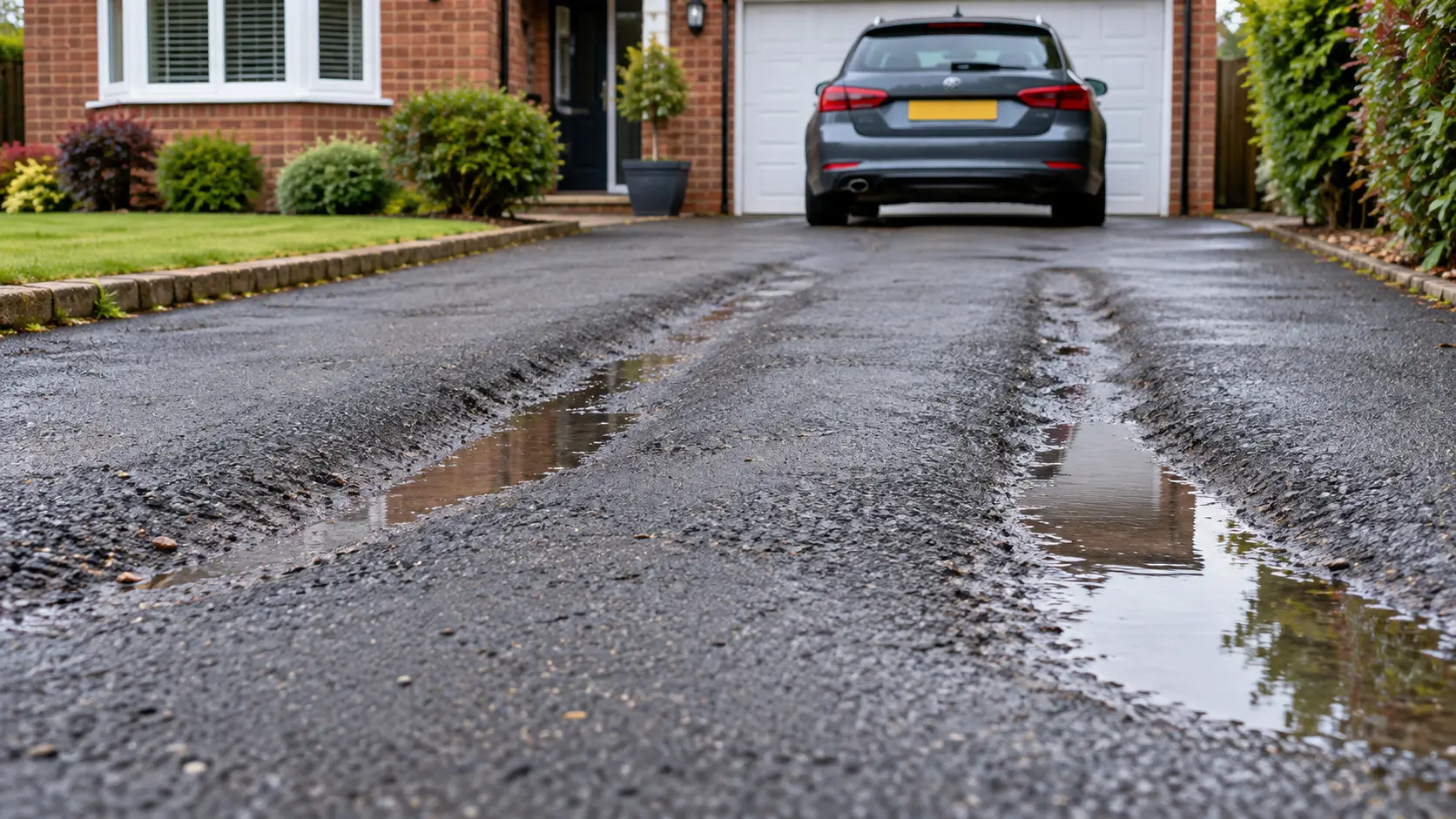
If you searched “why is my tarmac driveway sinking?”, start by finding what moved. The surface may have softened, the sub-base may have settled, or a drain frame may sit proud.
That distinction matters in 2026. Provisional Met Office figures published on 1 September put the summer mean at 16.5°C.
That made it the UK’s warmest recorded summer. The hottest day reached 38.2°C at Hartpury College on 13 August. Heat can soften bitumen near the surface. It cannot prove the foundation failed. Read the Met Office’s summer report.
My firm view: never accept an overlay quote until someone explains what supports the dip. A fresh black surface can hide movement for a while. It cannot stop a weak base from moving again. That is my answer to “why is my tarmac driveway sinking?” Start with the layer that moved. Planning a patch or a full relay? Our free tarmac calculator works out tonnage and cost from your area and depth.
Is the tarmac sinking, or did heat leave a surface mark?
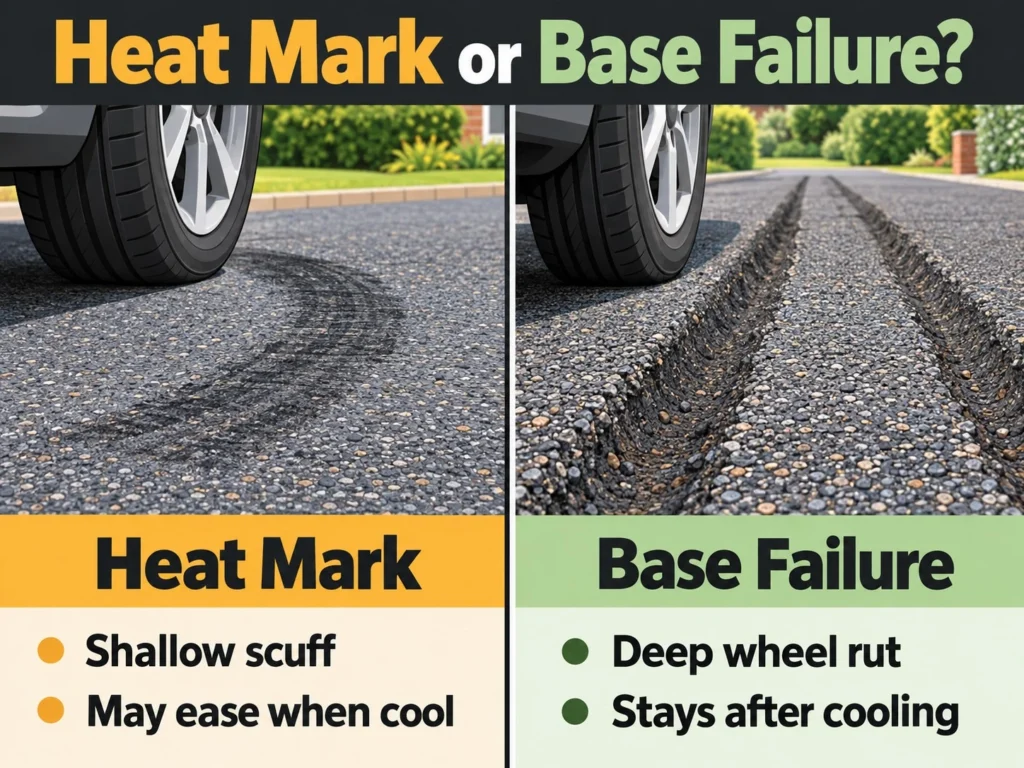
Tarmac, or asphalt, is a mix of stone held by bitumen. Hot weather can soften that binder. Slow turns, a parked vehicle or a heavy planter can then press or scuff the top.
Look closely. A surface scuff may feel tacky in heat or show tyre marks. It may leave a small ridge beside the indentation. It may feel firmer after cooler weather. A structural rut often forms a deeper channel along a wheel path. It stays visible after the surface cools.
The Asphalt Industry Alliance explained this in an article published on 12 August 2026. Heat may make surface particles more mobile. The effect often stays near the top. Prolonged heat with slow or stationary heavy traffic can raise deformation risk, especially where defects exist.
One hot day does not condemn the drive. Take a photo, note the weather, then recheck after cooler conditions. Measure any hollow that remains.
What does the shape of the dip tell you?
| What you see | Possible cause | What to check next |
|---|---|---|
| Two long troughs under the tyres | Repeated wheel loading, weak or poorly compacted support | Measure rut depth at several points |
| One shallow mark where a car turns | Hot surface scuff or local deformation | Compare on a cooler day |
| A dip around a drain cover | Loose backfill, poor compaction, or a moving frame | Check whether the frame or surrounding surface moved |
| A soft patch after rain | Water entry, saturated support, or a leak | Trace the water and inspect nearby drains |
| A falling edge | Missing edge restraint, erosion, or vehicle overrun | Look for loose edges and washed-out material |
| Repeated patches and cracks | Earlier repairs covered the symptom | Ask what lies under each patch |
Case study: the drain cover that looked higher. A DIYUK homeowner posted on 12 July 2026. They had lived with the drive about 12 years. The cover seemed higher, but replies split over whether the surround or chamber moved. The thread ended without a confirmed diagnosis or repair. Compare the cover with a fixed reference, such as a wall threshold or channel drain.
Why wheel-track ruts deserve a closer look
Parallel ruts usually matter more than one shallow mark. Repeated wheel loads act on the same narrow strips. If the foundation lacks support, the asphalt can deform or settle there first.
A weak sub-base is one possible cause. A soft subgrade, poor drainage, an overloaded vehicle, or a trench that was not compacted well can also contribute. The surface pattern narrows the search. It does not identify which layer failed.
How can you check a sunken driveway without digging it up?
Start with these checks. They will not replace an inspection. They will help you describe the problem and compare contractor quotes. People asking “why is my tarmac driveway sinking?” can start here before booking a visit.
- Photograph the dip from above and from the side. Include a ruler or tape for scale.
- Lay a straightedge across the rut. A long level or straight timber can work.
- Measure the deepest gap between the straightedge and the tarmac. Record the result in millimetres.
- Repeat the measurement at several points along the same wheel track.
- Note whether the surface feels firm, loose, soft or springy underfoot.
- Check the area after rain. Mark where water pools and where it should drain.
- Compare the tarmac with fixed levels. Use the garage threshold, kerb or drain frame.
- Take another set of photos after cooler, dry weather.
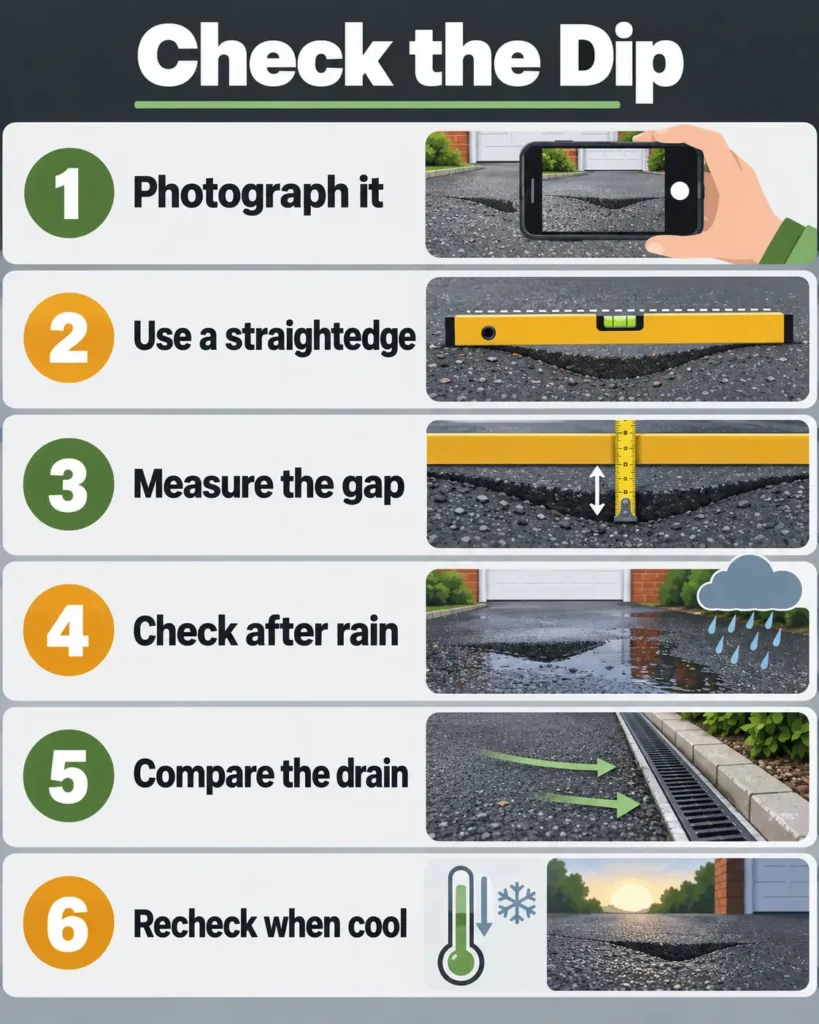
One measurement is not a repair specification. A driveway may need a drainage fall, so the surface will not always be level. Ask whether its shape changed. Check if water sits where it should not. Note whether the material moves under load.
Stop probing near a loose inspection cover, exposed services or a deep hole. Stop if the surface changed suddenly near the house. A drain or water leak can create a safety problem. Ask a qualified contractor to inspect it.
What if water collects in the hollow?
Standing water can enter cracks and joints. It may soften support layers. Repeated traffic can push the surface down further.
Check the full route. Water might come from a blocked channel, a downpipe, a leaking drain, or a poor driveway fall. A new gully will not help if the outfall has nowhere lawful or safe to go. In England, you should not assume a soakaway will work in heavy clay or a high water table.
The Planning Portal’s front-garden guidance says permeable surfacing can avoid permission for a new or replacement driveway. Directing water to a permeable area can also qualify. An impermeable surface over five square metres may need permission if runoff has no permeable destination. This rule dates from 2008. I found no new 2026 change.
When will a patch hold, and when must the base come up?
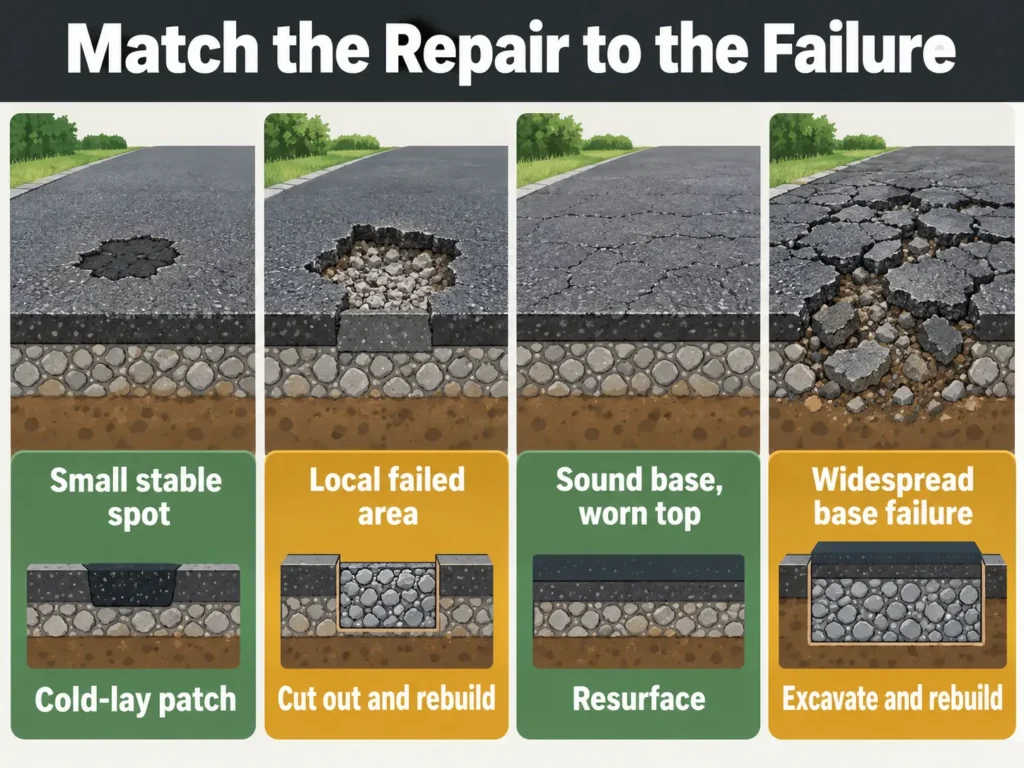
The right repair depends on the affected area and its support. “Add a layer of tarmac” is not a diagnosis. Asking “why is my tarmac driveway sinking?” does not justify another surface layer.
| Repair | Best fit | Main limitation |
|---|---|---|
| Cold-lay patch | Small, stable, shallow defect that needs a quick repair | It can look different and will not fix a moving base |
| Local cut-out and rebuild | A defined failed area with sound tarmac around it | The repair joint may remain visible |
| Resurface | Worn top course over a stable, well-drained base | Existing movement can reappear through the new layer |
| Full excavation and rebuild | Widespread rutting, failed support, poor levels or recurring repairs | Highest cost, disruption and waste |
When is cold-lay tarmac a sensible repair?
Cold-lay material is useful for some small repairs. It is easy to handle and can make a spot safer. But a tub of repair mix is not a foundation repair.
Remove loose material, follow product instructions and compact the patch properly. Do not pour it into a wet, soft depression. If the patch sinks again or water returns, stop adding more.
Case study: dents under a heavy planter. A DIYUK homeowner posted on 3 May 2025. Their tarmac showed impressions beneath a heavy planter. By February 2026, the owner planned to try cold mix on car depressions and worried about appearance. No repair result appeared in the thread. That gap matters. A proposed product is not proof that the cause has been solved.
When should the contractor cut out the failed section?
If one area has dropped while the rest remains firm, a contractor may cut out that section. They can remove the surface, inspect the base, replace unsuitable material, compact each layer, and relay the asphalt.
Ask what happens if excavation reveals more damage. The quote should state its assumed depth, materials, compaction method and drainage work. It should cover disposal, extra excavation costs and how the repair meets the existing surface.
When does resurfacing become wasted money?
Resurfacing can refresh a sound driveway. It cannot bridge a shifting base. Does the drive flex under a car? Does it have several wheel ruts or persistent puddles? Widespread cracking also calls for a base assessment before an overlay.
Some installers suggest walking across the surface or checking a crack with a screwdriver. Treat those as screening ideas, not universal engineering rules. A screwdriver test means little without controlled material, force and location.
This is the part many quotes skim over. Ask the contractor to show you the failed layer. If they recommend a full replacement, ask which observations support that scope. If they recommend resurfacing, ask how they know the base is stable.
What should a UK driveway repair quote include?
Ask each contractor to price the same scope. Otherwise, three quotes may describe three different jobs.
- The measured area and maximum depth of the repair
- Whether the existing tarmac will be cut out or covered
- The condition and replacement depth of the sub-base
- How the crew will compact the support material
- The asphalt mix and finished layer thickness
- Drain, chamber and edge-restraint work
- Waste removal, access, traffic control and delivery
- The price for extra excavation if hidden damage appears
- A written warranty and exclusions
Be wary of a quote that promises “a new top” without checking the surface levels, drainage and support. Also be wary of anyone who insists on replacing the whole drive after a quick glance. Ask for photos of the opened section or a written reason.
Cost depends on location, access, area, repair depth, waste, drainage and the contractor’s minimum charge. A small patch can cost more per square metre than a large job. Ask for a total price and a clear scope, not a national average presented as your exact bill.
The MyJobQuote 2026 guide separates labour, materials, sinking-section repairs, drainage and base work. Compare the work included, not just the total.
How much asphalt should you order after choosing the repair?
Measure only after you know the repair footprint and finished depth. Length multiplied by width gives the area. Area multiplied by compacted depth gives the volume. Asphalt tonnage also depends on the mix density and allowance for edges, joints and normal waste.
For example, a rectangular repair measuring 2 metres by 1.5 metres covers 3 square metres. At a proposed compacted depth of 50 millimetres, the geometric volume is 0.15 cubic metres before any allowance. A contractor must set the suitable depth and mix for the actual job.
You can use the BrickCalculator asphalt and tarmac calculator to estimate tonnage and material cost. The calculator does not decide whether your base is sound or set the structural design. Confirm the mix, delivery minimum and final order with your supplier.
If the repair includes a rebuilt base, review how to estimate MOT Type 1 for a project. Keep the sub-base quantity separate from the asphalt quantity. That makes a contractor’s quote easier to check.
What is the safest next step?
Mark the dip and measure it. Photograph it in warm and cool weather. Check again after rain. Note the nearest drain, edge, garage threshold and wheel path. If you still ask “why is my tarmac driveway sinking?”, show those observations to the contractor.
Ask a contractor one direct question: “Which layer failed?” Then ask how they will confirm it. A good repair starts with that answer. The new black finish comes later.