How Much MOT Type 1 Do I Need? Get the Right Tonnes, Bags and Depth First Time
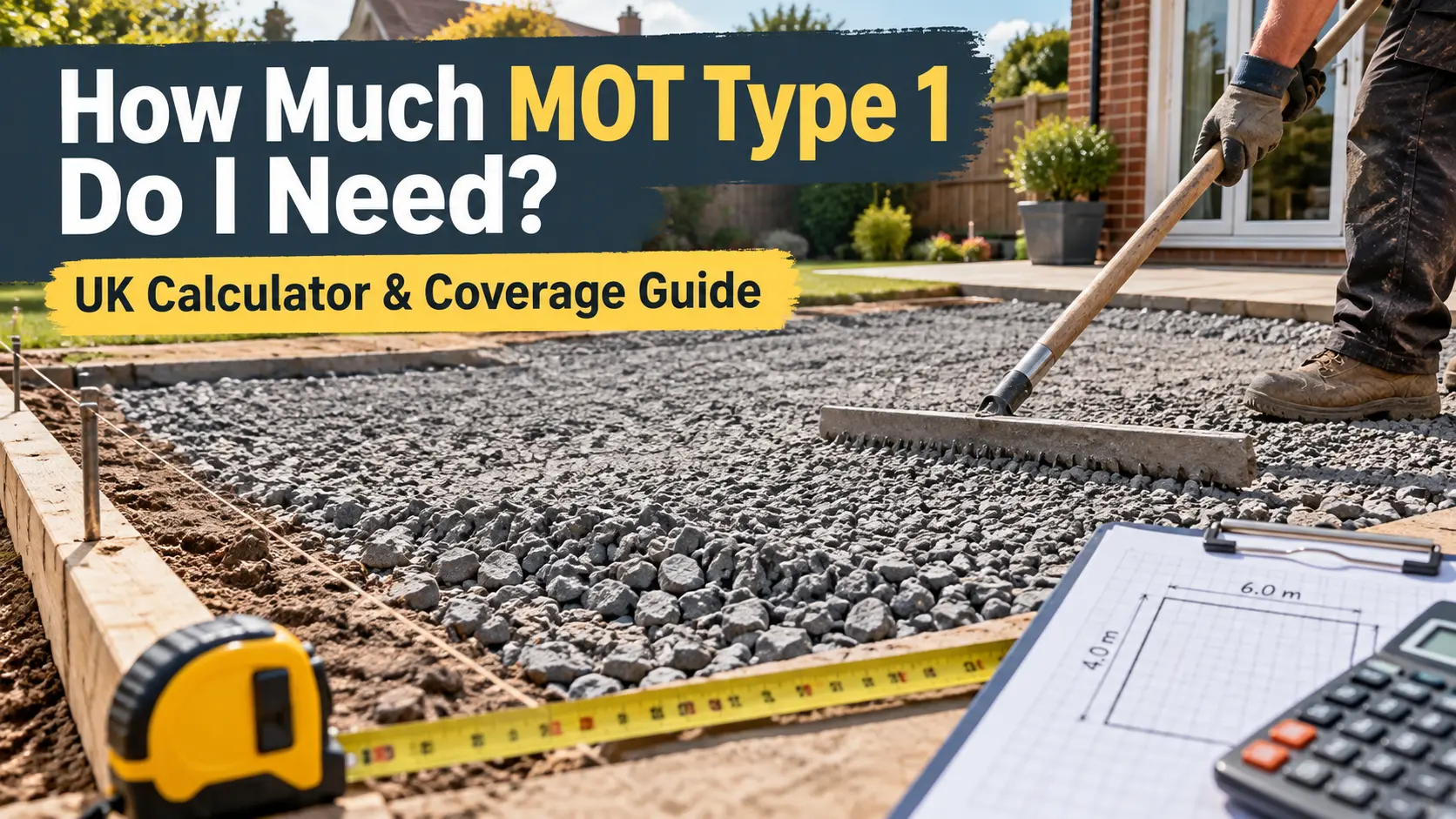
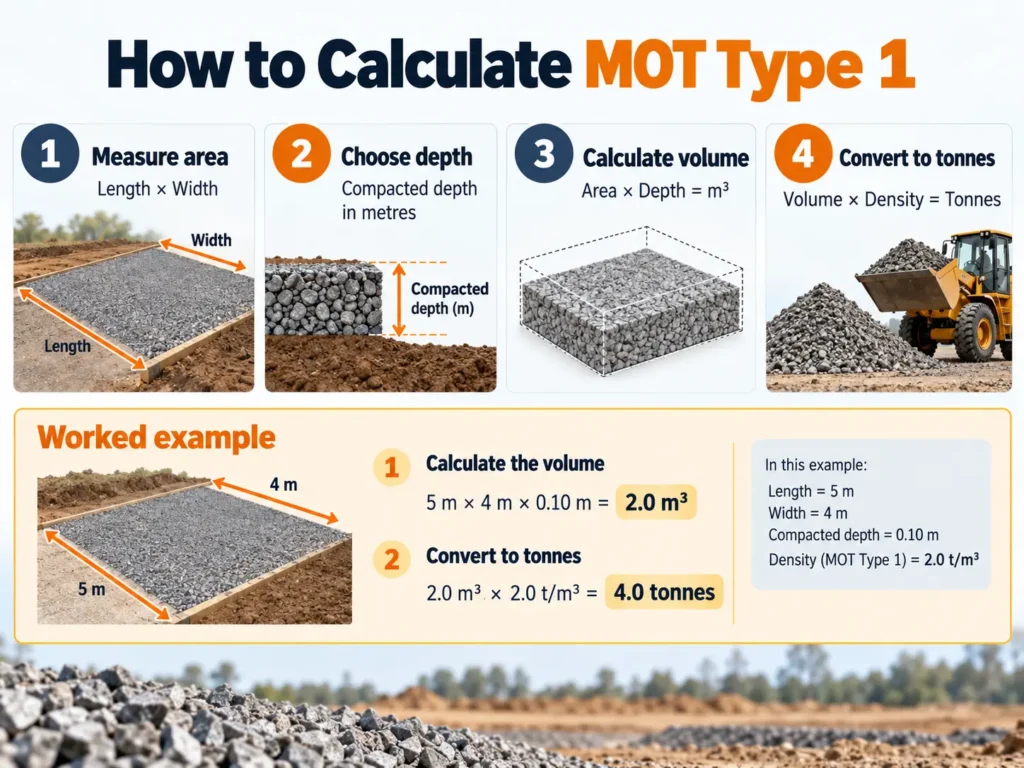
If you are asking “how much MOT Type 1 do I need?”, start with three numbers. You need the area, finished compacted depth, and a realistic bulk density. For a rectangle, multiply length by width. Then multiply that area by depth in metres. That gives cubic metres. Multiply the volume by bulk density to estimate tonnes.
Simple, right? Mostly. The trap appears one step later. Many guides treat one density figure as universal. It is not. MOT Type 1 varies with source, grading, moisture, and supplier data. A sensible planning value is useful, but it should never be hidden from the reader.
For the fastest estimate, use the MOT Type 1 and Aggregate Calculator. It lets you work with rectangles, circles, L-shaped areas, tonnes, bulk bags, and small bags.
Here is the principle that matters most. Keep the geometry, density, and ordering allowance separate. That one habit prevents most quantity mistakes and makes supplier quotes much easier to compare.
How much MOT Type 1 do I need?
The basic calculation is straightforward. First calculate the finished volume. Then convert that volume to tonnes using a stated density.
- Area × compacted depth = volume in cubic metres
- Volume × bulk density = estimated tonnes
Take a 5m by 4m patio. Its area is 20m². At 100mm compacted depth, you need 2.0m³. At 2.0t/m³, that equals 4.0 tonnes before any ordering allowance.
That is the clean calculation, and I would keep it clean. A lot of online advice immediately adds 20% or 25% “for compaction”. I would not do that automatically. Your density assumption may already represent material close to its compacted condition. Adding another large percentage can then overstate the order.
This is where my own thinking changed while researching the current UK results. Different calculators use figures ranging from roughly 1.8 to 2.2t/m³. The lesson is more useful than any single number. Always show the density assumption.
That small detail can prevent both expensive outcomes: a second delivery, or a mound of stone you never needed.
How much area does one tonne of MOT Type 1 cover?
One tonne does not have one fixed coverage figure. Depth changes the answer dramatically. The table below uses a planning density between 2.0 and 2.1t/m³. Treat these figures as useful checks, not supplier guarantees.
| Compacted depth | Approximate coverage from 1 tonne |
|---|---|
| 50mm | 9.5 to 10.0m² |
| 75mm | 6.3 to 6.7m² |
| 100mm | 4.8 to 5.0m² |
| 150mm | 3.2 to 3.3m² |
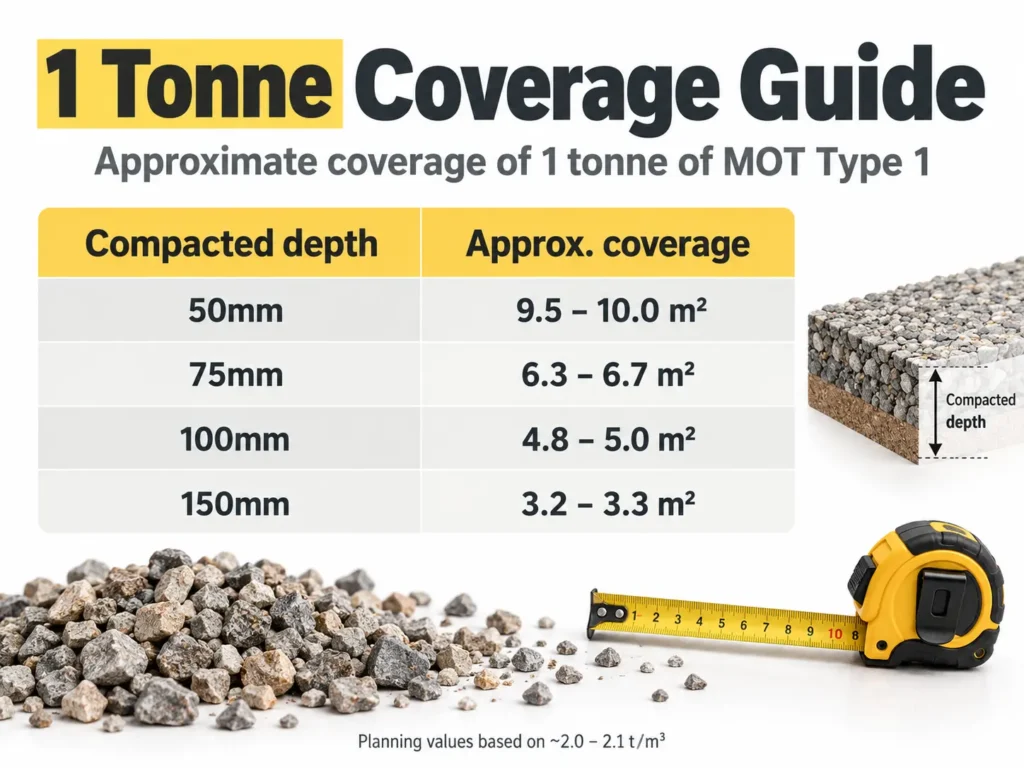
The method is simple. Divide one tonne by the assumed density to get cubic metres. Then divide that volume by the chosen depth.
How much does one tonne cover at 50mm?
At 50mm compacted depth, one tonne covers roughly 9.5 to 10m².
How much does one tonne cover at 100mm?
At 100mm compacted depth, expect about 4.8 to 5m² per tonne
How much does one tonne cover at 150mm?
At 150mm compacted depth, expect roughly 3.2 to 3.3m² per tonne. These figures are excellent for checking a quote. They are not a reason to ignore the supplier’s product data.
How do you convert cubic metres to tonnes without double-counting compaction?
This is where sensible-looking calculations often go wrong. I recommend treating the job as three separate calculations:
- Measure the finished area and required compacted depth.
- Convert that geometric volume into tonnes using a stated density.
- Add only the allowance needed for site variation, spillage, trimming, or supplier minimums.
Do not hide all three inside one “compaction factor”. Finished compacted volume describes the space your sub-base must occupy. Loose delivered material describes what arrives on site. Those figures are related, but they are not identical.
For technical reference, see the official Specification for Highway Works material. It explains the formal specification background behind Type 1 material.
What depth of MOT Type 1 do I need?
This question causes more trouble than the calculator itself. There is no universal depth for every garden in Britain. A patio on firm ground in Kent is not the same job as a driveway over wet clay in Manchester. Use the following figures as planning ranges.
| Project | Typical compacted planning range | What can change it |
|---|---|---|
| Patio or path | 75 to 100mm | Clay, weak ground, drainage, paving system |
| Domestic driveway | 100 to 150mm | Vehicle loads, weak formation, drainage |
| Shed or garden-building base | 75 to 100mm | Building weight and foundation method |
| Permeable paving | Project specific | Drainage design and specified aggregate |
Recent UK patio guidance from Pave Direct’s patio sub-base guide uses about 100mm compacted Type 1 for domestic patios and discusses heavier build-ups where vehicles or poor ground are involved.
Patios and paths
For ordinary pedestrian use, 75 to 100mm gives a sensible planning range. Do not confuse sub-base depth with total excavation depth. Your bedding layer and paving still sit above it.
Driveways
Domestic driveways often begin around 100 to 150mm compacted. Heavier vehicles and weak formation can require a different build-up.
Clay, soft ground, and made ground
This is where generic internet advice starts falling apart. If the formation pumps beneath a plate compactor, another 25mm may not fix anything. Waterlogging and mixed fill also need attention. Drainage, separation, excavation, or a designed construction can matter more.
Here is the uncomfortable opinion: more Type 1 is not always better. Sometimes it is simply more Type 1.
What does a real MOT Type 1 calculation look like?
Here are three examples using 2.0t/m³ as a planning density. These are quantity examples, not structural designs.
Example 1: 20m² patio
A 20m² patio at 100mm gives 20 × 0.10 = 2.0m³. Then 2.0m³ × 2.0t/m³ = 4.0 tonnes. Add a 5% site allowance and the estimate becomes 4.2 tonnes.
Now change only the density to 2.1t/m³. The base quantity becomes 4.2 tonnes before the allowance. That difference looks tiny in a spreadsheet. On site, it can decide whether another bag is needed.
Example 2: 40m² driveway
At 150mm compacted depth, 40 × 0.15 = 6.0m³. At 2.0t/m³, that equals 12.0 tonnes. Add 5% for site variation and the figure becomes 12.6 tonnes.
At this scale, compare bulk bags against a loose tipped load. Bag convenience can become surprisingly expensive once quantities reach double-digit tonnes.
Example 3: irregular garden path
Split awkward areas into simple rectangles. A 6m by 1m section equals 6m². Another 4m by 0.8m section equals 3.2m². Total area is 9.2m². At 75mm depth, the volume is 9.2 × 0.075 = 0.69m³. At 2.0t/m³, you need about 1.38 tonnes before any allowance.
How many bulk bags of MOT Type 1 do I need?
First, forget the idea that one bulk bag always equals one tonne. It often does not. Suppliers may offer 800kg, 850kg, or 1,000kg bags. Use the actual stated bag weight.
Imagine your estimate is 4.2 tonnes. With an 850kg bag, 4.2 ÷ 0.85 = 4.94 bags. You cannot order 0.94 of a bag, so you round up to five bags.
For larger projects, compare bags with loose delivery. Also check vehicle access, crane reach, unloading space, and tipping restrictions. Those boring logistics can wreck an otherwise perfect calculation.
How can you tell if delivered MOT Type 1 is good quality?
This is the part most calculators ignore, yet DIY communities keep asking about it. A useful Type 1 sub-base needs a graded mixture. Larger particles provide structure. Fine material fills spaces and helps the aggregate lock during compaction.
What does “boney” Type 1 mean?
Tradespeople often describe overly coarse material as “boney”. It can appear short of fines and may remain mobile beneath a plate compactor.
Do not condemn an entire bulk bag from its top layer. Transport can separate coarse and fine particles. Finer material can settle lower in the bag. Rake and remix it first.
Recycled Type 1 also deserves a fairer reputation. It is not automatically second-rate. Specification, grading, and contamination control matter more than whether every particle came directly from a quarry.
For a current industry example, see Agg-Net’s Ecoblend recycled aggregate trial coverage. It reports a mainstream trial using recycled construction and demolition material in Type 1 production.
Do I need a membrane under MOT Type 1?
Sometimes. A geotextile can separate the sub-base from weak clay, silt, or mixed ground. It can also reduce migration between the layers.
On firm granular formation, the benefit may be smaller. A permeable paving system may also require a specific membrane arrangement. Treat the membrane as part of the whole construction, not as a magic fix.
What is the difference between MOT Type 1 and Type 3?
MOT Type 1 is densely graded and contains fines. Those fines help create a tight, compacted layer. Type 3 is more open graded and is often selected where greater permeability matters.
That difference can become crucial with permeable paving. Simply increasing Type 1 depth may work against the drainage strategy.
For other materials and project types, browse the full Construction Calculators collection.
What changed for aggregate buyers in 2026?
MOT Type 1 is densely graded and contains fines. Those fines help create a tight, compacted layer. Type 3 is more open graded and is often selected where greater permeability matters.
That difference can become crucial with permeable paving. Simply increasing Type 1 depth may work against the drainage strategy.
For other materials and project types, browse the full Construction Calculators collection.
What changed for aggregate buyers in 2026?
There are two developments worth knowing. First, the Aggregates Levy increased on 1 April 2026 in England, Wales, and Northern Ireland. The rate moved from £2.08 to £2.16 per tonne. Scotland moved to the separate Scottish Aggregates Tax on the same date.
For the current official rate, check the GOV.UK Aggregates Levy rates.
That does not mean every merchant raised delivered prices by exactly 8p per tonne. Haulage, fuel, source, bagging, and regional competition matter too.
Second, recycled and blended aggregates are becoming more visible in mainstream merchant supply. I expect that trend to continue. The argument will increasingly shift away from “recycled versus proper”. Buyers will care more about verified performance, transport distance, local availability, and price.
What are the most common MOT Type 1 mistakes?
- Entering 100 instead of 0.10 when converting 100mm into metres.
- Assuming every bulk bag weighs exactly one tonne.
- Adding a large compaction allowance after already using a compacted density.
- Ordering by square metres without considering depth.
- Spreading one thick layer and expecting a light plate compactor to solve everything.
- Ordering before checking access for the delivery vehicle.
The last mistake is easy to laugh at until it happens. A perfect tonnage calculation means very little when the delivery vehicle cannot reach the site.
Frequently Asked Questions (FAQ’s)?
Calculate it once, then order with confidence
If you still ask “how much MOT Type 1 do I need?”, do not start by counting bags. Start with finished area and compacted depth.
Convert that volume to tonnes using a clearly stated density. Add a separate ordering allowance. Then divide by the actual bag weight or compare loose delivery.
It is a boring sequence in the best possible way. Every assumption stays visible, which means fewer surprises when the lorry arrives.
Use the Aggregate Calculator for your final quantity check. If the project also includes a slab or footing, the Concrete Calculator can estimate the next material stage.