Get Back on Your Concrete Safely, Without Guessing at the Cure Time
Concrete looks solid long before it reaches its intended strength. That gap causes most confusion about when you can use a new patio, shed base, footing or driveway.
Here is the short answer: You can often walk carefully on concrete after 24 to 48 hours, while a passenger car usually needs at least seven days. Heavy vehicles and full design loads generally wait longer, often until the 28-day strength benchmark. Cold weather, the concrete mix and the job’s design can change those times.
Those numbers are guides, not permission slips. A slab’s surface can feel hard while its strength continues to develop. And “28 days” does not mean every project must stay untouched for four weeks.
One honest note before we go further: I do not have personal site experience to claim. So I will not invent a dramatic story about a ruined driveway. Instead, I’ll use published technical guidance, two real homeowner questions from public forums, and clearly labelled worked examples.
Still planning your pour? Our free concrete calculator works out cubic metres, bags and cost before you start.
How long does concrete take to cure?
For many domestic jobs, concrete becomes firm enough for careful foot traffic in 24 to 48 hours. A passenger car often waits at least seven days. Heavy vehicles, skips and construction equipment may need to stay away for 28 days or until the concrete reaches its specified strength.
Those common timings assume suitable concrete, proper curing and mild conditions. They do not cover every mix or load.
| Use or milestone | Common planning guide | What the number means |
|---|---|---|
| Careful foot traffic | 24–48 hours | The surface may support a person, but it can still scuff or mark. |
| Passenger car on a driveway | At least 7 days | A common supplier recommendation for a typical domestic driveway. |
| Heavy vehicles or skips | Around 28 days, or as specified | The load and slab design matter. Ask the installer or engineer. |
| Specified strength test age | Often 28 days | A common age for checking concrete strength, not a universal “finished curing” date. |
| Tiling, sealing or flooring | Product-specific | Strength readiness does not prove the slab is dry enough for a finish. |
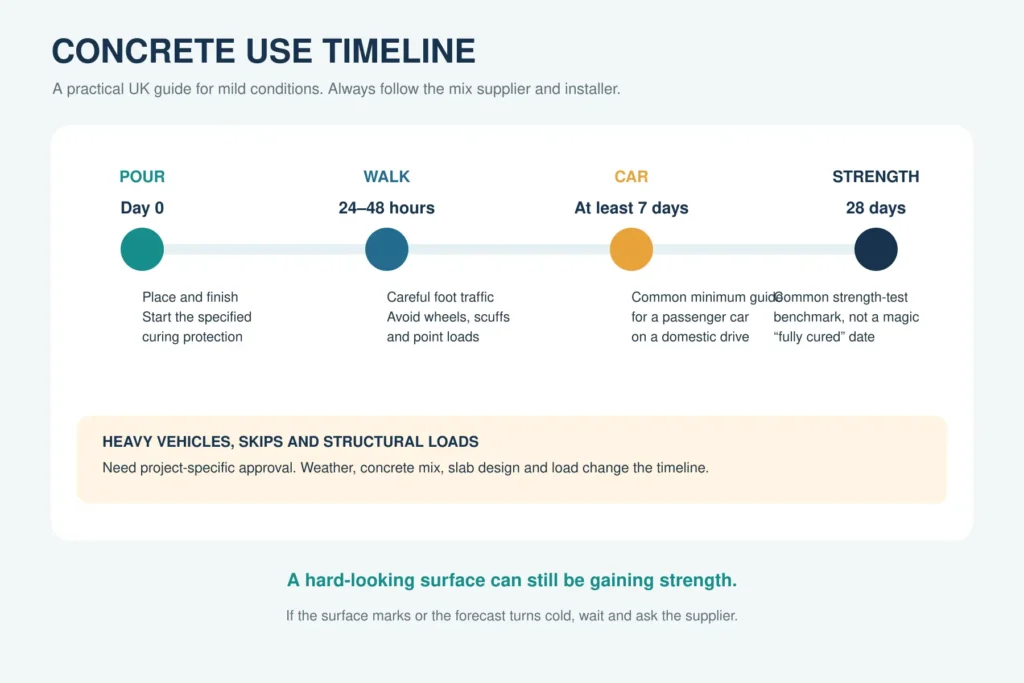
Suppliers including Rock Solid give similar walk-on, car and heavy-load milestones. Yet their own guidance also says weather, mix and slab conditions affect the actual timing.
Why do guides say 28 days?
Why do guides say 28 days?
Concrete gains strength through cement hydration, a reaction between cement and water. Strength develops quickly at first, then more slowly. Many concrete grades use 28 days as a standard age for reporting compressive strength.
That benchmark does not mean hydration stops on day 28. It also does not mean you must leave every patio unused for a month. A passenger car on a domestic driveway is a different load from a skip lorry turning on a slab edge.
The stronger question is not simply, “Has it cured for 28 days?” Ask, “What load was this concrete designed for, and what does its supplier recommend?”
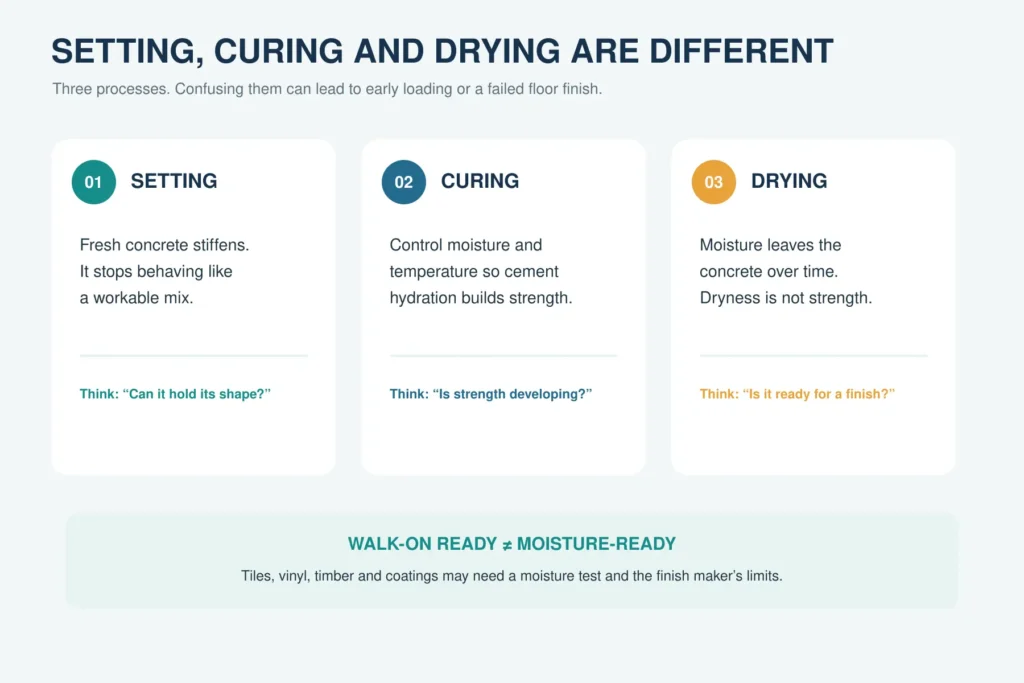
What is the difference between setting, curing and drying?
These words get swapped around online, but they describe different things.
- Setting is when fresh concrete stiffens and stops behaving like a workable mix.
- Curing means controlling moisture and temperature so hydration can develop strength and durability.
- Drying means moisture leaves the concrete. It does not create strength.
Concrete does not need to “dry out” to become strong. In fact, early moisture loss can interfere with hydration and increase the risk of surface cracking. The Concrete Society defines curing as preventing moisture loss while maintaining a suitable temperature. It describes typical curing periods in the order of four to six days, while specifications and conditions may require different periods.
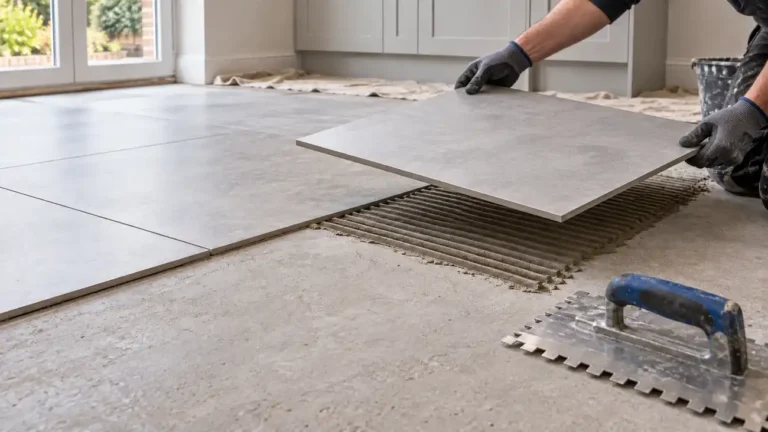
This distinction matters if you plan to install tiles, vinyl, timber flooring, a coating or a sealer. A surface may support foot traffic but still contain too much moisture for the finish. Follow the flooring or coating manufacturer’s moisture limits and test method.
When can I walk, drive or build on new concrete?
Start with the supplier’s instructions. Then consider the load, the mix, the thickness, the base and the weather.
Walking on a patio or path
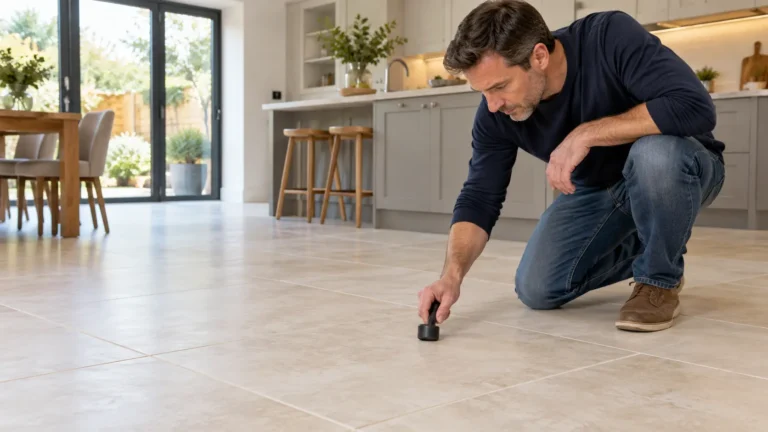
Plan for 24 to 48 hours before light foot traffic under reasonable conditions. Stay off longer if the weather is cold, the surface still marks, or the installer gives a longer period.
Once access is allowed, walk carefully. Avoid dragging bins, ladders or heavy planters across the surface. A person’s weight spread over shoes differs from a narrow ladder foot or a wheelbarrow load.
Parking a car on a new driveway
Seven days is a common minimum guide for a passenger car. Do not treat that as a guarantee for a van, trailer, motorhome or vehicle that will turn sharply on the slab.
Braking and steering can put more stress on the surface than a car sitting still. Edges also deserve care because they may receive less support from the sub-base.
For a structural slab, a commercial driveway, a heavy vehicle or an uncertain mix, get the installer’s advice. They know the concrete grade, water-cement ratio, reinforcement, sub-base and intended loading.
Building on a slab or footing
Do not rely on a generic blog timetable to decide when a wall, frame or other structural load can go on concrete. The correct timing depends on the design, concrete specification, weather and load sequence.
A related BrickCalculator guide explains how to estimate concrete volume for garden wall footings. That quantity calculation cannot confirm that a footing is properly designed or ready to carry a wall.
What does “full strength” actually mean?
A grade such as C28/35 refers to concrete strength measured on a cylinder and a cube at 28 days. The two figures differ because the test shapes produce different results. Heidelberg Materials explains this strength notation in its guide to UK concrete types and grades.
The actual grade and exposure class matter. For outdoor UK paving, the Concrete Society identifies PAV1 for domestic drives and parking, and PAV2 for heavy-duty external paving. Those designations concern the concrete’s suitability for exposure and use. They are not extra cure-time promises.
How does cold weather change concrete curing time?
Cold concrete gains strength more slowly. Frost can do worse than delay the job. If young concrete freezes, it can suffer damage before it has enough strength to resist it.
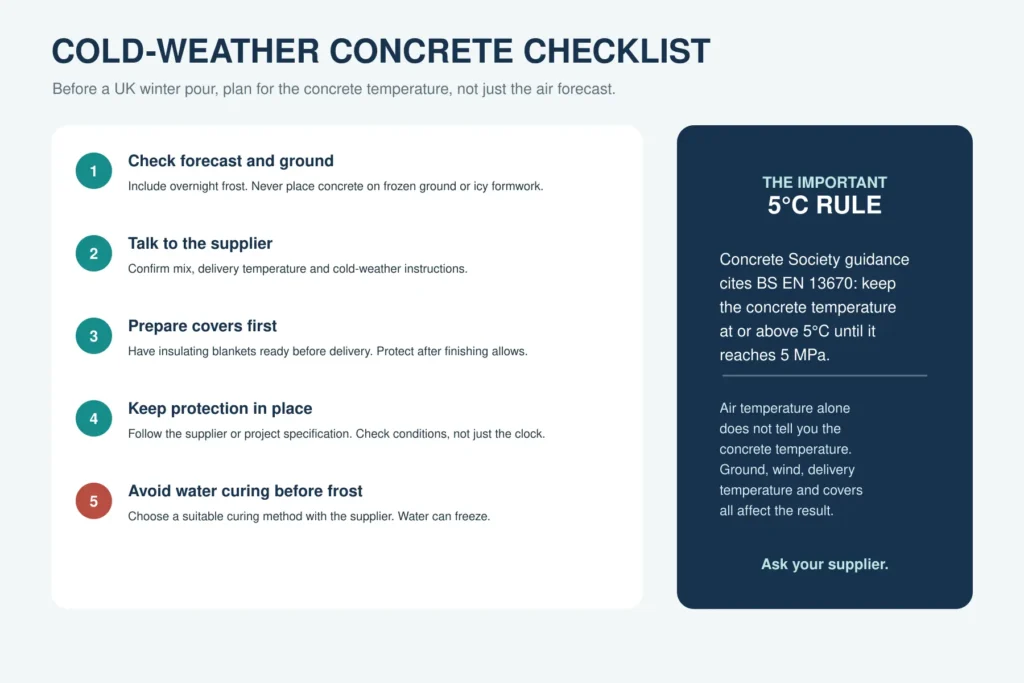
The Concrete Society’s cold-weather guidance cites BS EN 13670: concrete temperature should not fall below 5°C until it reaches 5 MPa. It also says the surfaces that contact fresh concrete, including the sub-base, should be a few degrees above freezing. Do not pour onto frozen ground or surfaces covered in ice.
A forecast air temperature alone cannot tell you the concrete temperature. The ground, wind, concrete delivery temperature, slab thickness and protection all play a part.
A practical cold-weather checklist
Before a UK winter pour:
- Check the forecast for the full first few days, including overnight frost.
- Make sure the sub-base, formwork and reinforcement are clear of ice and snow.
- Ask the supplier about mix design, delivery temperature and cold-weather precautions.
- Have insulating covers ready before the truck arrives.
- Protect the concrete as soon as finishing allows, while following the specified curing method.
- Keep protection in place for the period advised by the supplier or project specification.
- Do not use water curing if freezing is expected.
The Concrete Society also notes that some ready-mix suppliers can provide heated concrete. That can help, but it does not replace fast placement and suitable insulation. Cemex’s concrete curing guide advises choosing winter pour days that avoid freezing during the first 24 to 48 hours where possible.
Important: Some supplier guides publish simple temperature cut-offs. Treat those as that supplier’s practical rules, not a universal standard for every mix and job.
How should I protect fresh concrete while it cures?
The right method depends on the mix, finish, weather and project specification. Common options include:
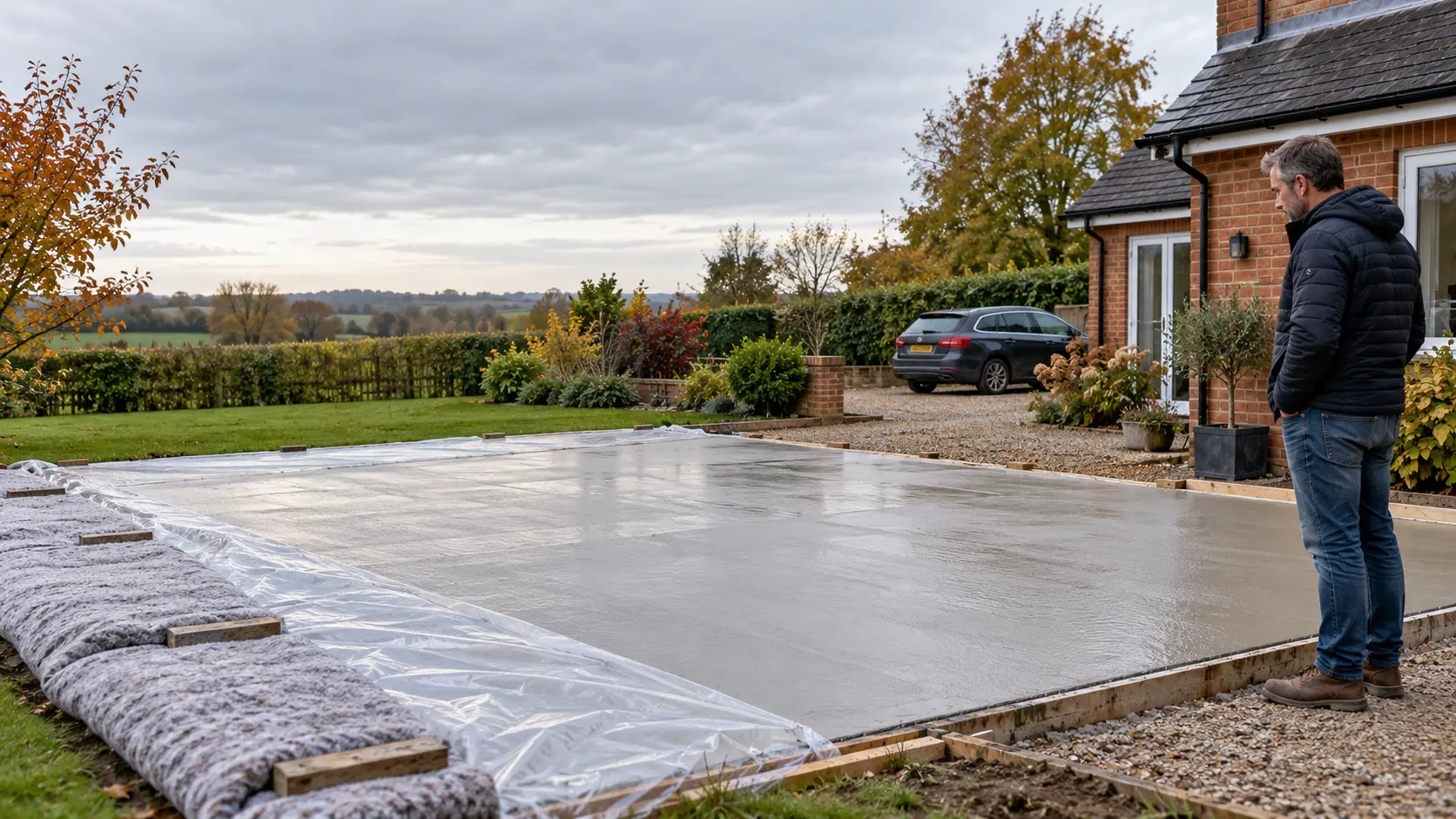
- Polythene sheeting: Helps limit moisture loss. Secure the edges and avoid damaging the surface.
- Damp hessian or another wet covering: Can keep the surface moist when conditions allow. Check that it will not freeze.
- Curing compound: Forms a moisture-retaining layer. Check compatibility before applying coatings or finishes.
- Insulating blankets: Help protect young concrete from cold. They do not remove the need to monitor conditions.
Heidelberg Materials says many specifications require curing periods of around three to seven days. It also identifies the first 24 hours as especially important for limiting moisture loss. The exact requirement depends on the concrete and conditions.
Here is the contrarian point: “Keep it wet” is not a complete curing plan. A curing compound, sealed sheet or damp covering may be more suitable. In freezing conditions, adding water can create a new risk.
Do not add water to the truck or mix to make concrete easier to place unless the supplier approves it. Extra water changes the mix’s water-cement ratio and can reduce performance.
What changes the curing timeline besides temperature?
Temperature gets the headlines, but it is only one factor.
- Cement type and cement replacement materials: Some mixes gain early strength more slowly. GGBS and fly ash can affect the rate.
- Admixtures: Accelerators and retarders alter setting or strength development. Use the supplier’s product data.
- Water-cement ratio: Excess water can change strength and surface quality.
- Slab thickness: A thick section retains heat differently from a thin edge. Thickness alone does not approve early loading.
- Wind and humidity: Dry, windy conditions can pull moisture from the surface.
- Sub-base and formwork: Cold ground and steel formwork can draw heat from fresh concrete.
- Exposure and mix specification: A domestic patio and a heavily loaded external surface may need different concrete.
That’s why I would trust a supplier’s project-specific instruction over a copied chart. A chart cannot see the ground, the finish, the mix ticket or the vehicle you intend to park.
Two real questions reveal the mistakes people make
These are public forum questions, not controlled studies. They show how people describe the problem when they are standing beside a new pour.
Case study: “Can I drive on it after four days?”
A homeowner on Reddit said a driveway was poured on Saturday. The contractor suggested driving on it the following Wednesday. Replies disagreed. Some cited the 28-day benchmark. Others pointed out that strength-test age and opening a surface to traffic are different questions.
The useful lesson is not “four days is fine” or “four days is always too soon.” Ask what mix was supplied, what vehicle will use it, what the weather did, and what the installer specified.
Case study: “It looks dry, but my shed is damp”
Another homeowner reported a four-inch shed slab poured two weeks earlier. The slab looked dry, but the shed thermometer showed 80% relative humidity. Replies correctly challenged the word “dry” and separated strength gain from moisture leaving the slab.
A dry-looking surface cannot prove readiness for flooring or a coating. Check moisture using the method required by the finish manufacturer. Ventilation may help a shed, but it is not a substitute for a proper slab moisture test.
These examples are why I avoid pretending one number answers every “when can I use it?” question.
What should I do if the concrete was poured in cold weather?
Do not panic over a cold night, but do not guess either. Contact the installer or supplier and share the pour date, mix information, overnight temperatures, covering method and intended load.
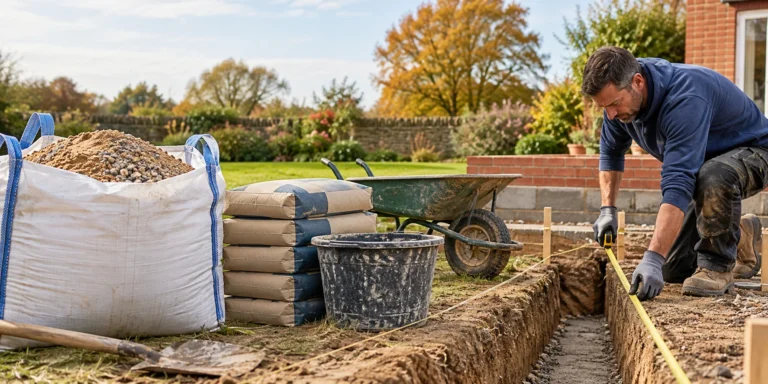
If you are planning a future pour, first estimate the volume with the UK concrete calculator. Then check delivery access, the sub-base and the forecast before booking. Quantity and curing are different planning problems, but both can derail a pour if left until the last minute.
In September 2026, the Concrete Society said its revised Good Concrete Guide 8 was due in November 2026. The update is intended to cover current practical guidance, including cold and hot weather concreting and curing. That is a reason to check for the new edition later this year. It is not evidence that standard walk-on or drive-on timelines have changed.
Frequently Asked Questions (FAQ’s)?
The safest rule is simple
Use 24 to 48 hours for careful walking, at least seven days as a common passenger-car guide, and 28 days as a frequent strength-test benchmark. Then adjust for the actual mix, temperature, curing method, slab design and load.
The number that matters most is not the one printed on a generic timeline. It is the instruction that matches the concrete delivered to your site and the job you need it to carry.
Sources for readers
The Concrete Society: Curing concrete
The Concrete Society: Cold weather concreting
The Concrete Society: External paving and BS 8500 requirements
Heidelberg Materials: Curing ready-mixed concrete
Concrete Society Technical Committee update, September 2026