Stair Calculator
Use this UK stair calculator to estimate the number of risers and treads, individual rise and going, total horizontal run, pitch angle, stringer length and an optional floor-opening or headroom value. Select the private-stair guidance profile for England, Wales, Scotland or Northern Ireland, enter your finished dimensions, and review each dimensional check.
This is a planning and dimensional screening tool, not Building Control approval. Stair rules depend on the jurisdiction, building type, use and full design. Confirm the current requirements for your project before construction.
Calculate your staircase dimensions
Calculate uniform risers, going, total run, pitch, stringer length and an optional headroom estimate. Results include a dimensional check against the selected UK private-stair guidance profile.
Does a passing result prove Building Regulations compliance?
No. A pass means the dimensions checked by the calculator are within the selected private-stair guidance profile. It is not Building Regulations approval and does not assess the complete stair, structure, landings, handrails, guarding, fire safety, access requirements or project-specific conditions.
How do I calculate stairs in the UK?
Measure the finished floor-to-floor rise, choose a whole number of risers, and calculate the individual rise. Enter the individual going or total horizontal run to calculate the number of treads, overall run, pitch and stringer length. Then compare the result with the private-stair guidance for England, Wales, Scotland or Northern Ireland.
How to use the UK stair calculator
- Select units and guidance profile. Metric is recommended for UK regulatory checks. Choose the nation in which the work will be carried out.
- Choose the mount and run mode. Standard mount normally treats the upper floor as the final level; flush mount adds a tread at the upper level. Enter either an individual going or the total horizontal run.
- Enter the total rise. Measure vertically from the finished lower-floor level to the finished upper-floor level. Include the thickness of finishes that will be present when the stair is used.
- Add optional constraints. Fixed Rise preserves the entered regular riser height; Fixed Number of Steps uses the entered count. Use only one constraint at a time and clear the unused optional value before recalculating. Tread thickness, nosing and headroom inputs are optional.
- Calculate and review every check. A pass means the entered or calculated value is inside the selected dimensional range. It does not confirm the whole stair is compliant.
Standard and flush mount options
These options control how the calculator treats the upper floor and top tread when calculating the number of treads, total horizontal run and stringer geometry. They are calculator layout settings, not separate Building Regulations stair categories.
Standard mount
The upper floor or landing forms the final level of the flight, so the top tread is positioned one rise below it.
- For a typical straight flight, the calculator normally uses one fewer tread than risers.
- Select this option when the upper floor or landing provides the final walking surface.
- The selected arrangement affects the tread count, total horizontal run and calculated stringer length.
Flush mount
A separate top tread is positioned at the same level as the upper floor or landing.
- The calculator includes the additional top tread, so the number of treads can equal the number of risers.
- Select this option only when the proposed stair detail includes a tread at upper-floor level.
- Landing dimensions, headroom, guarding, connections and structural support still require separate checking.
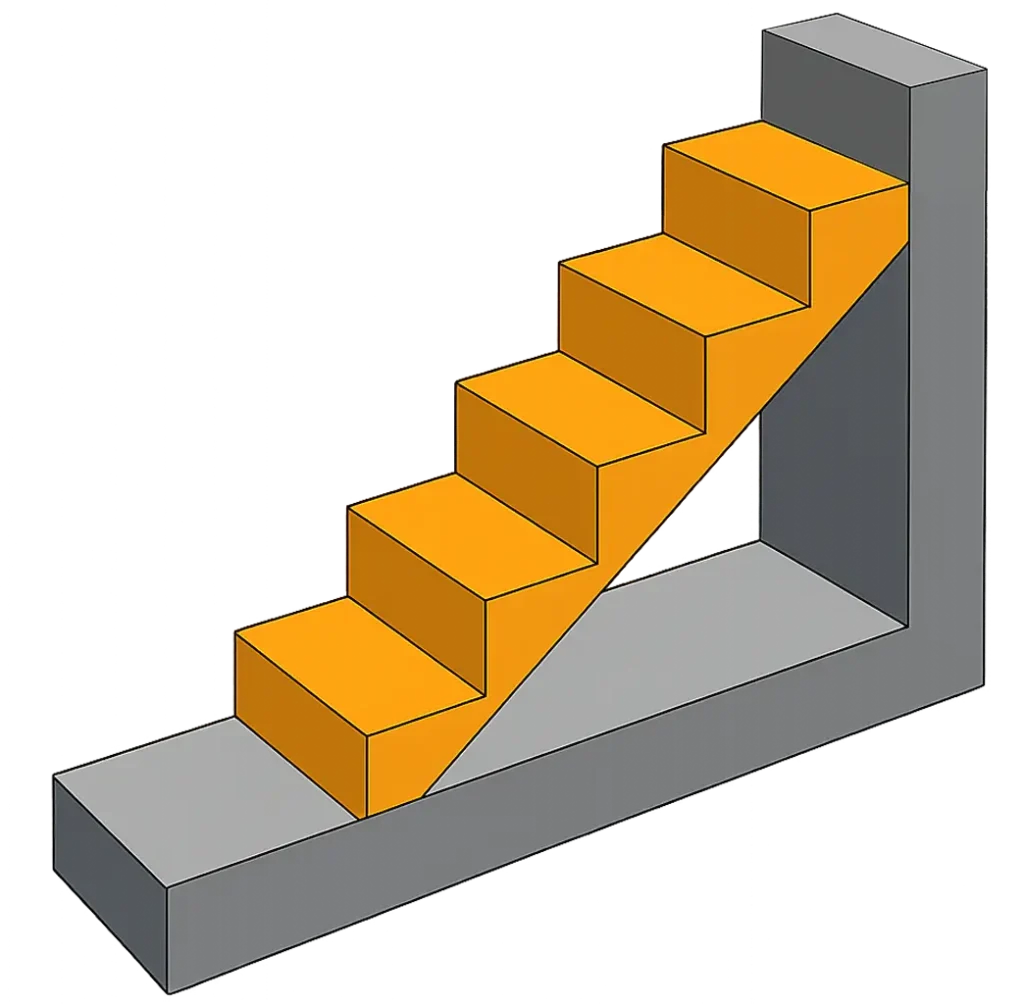
Flush Mount
A separate top tread is set level with the upper floor or landing.
- The additional top tread can make the tread count equal to the riser count.
- Use only when the stair detail includes a tread at upper-floor level.
- Check landing, headroom and structural details separately.
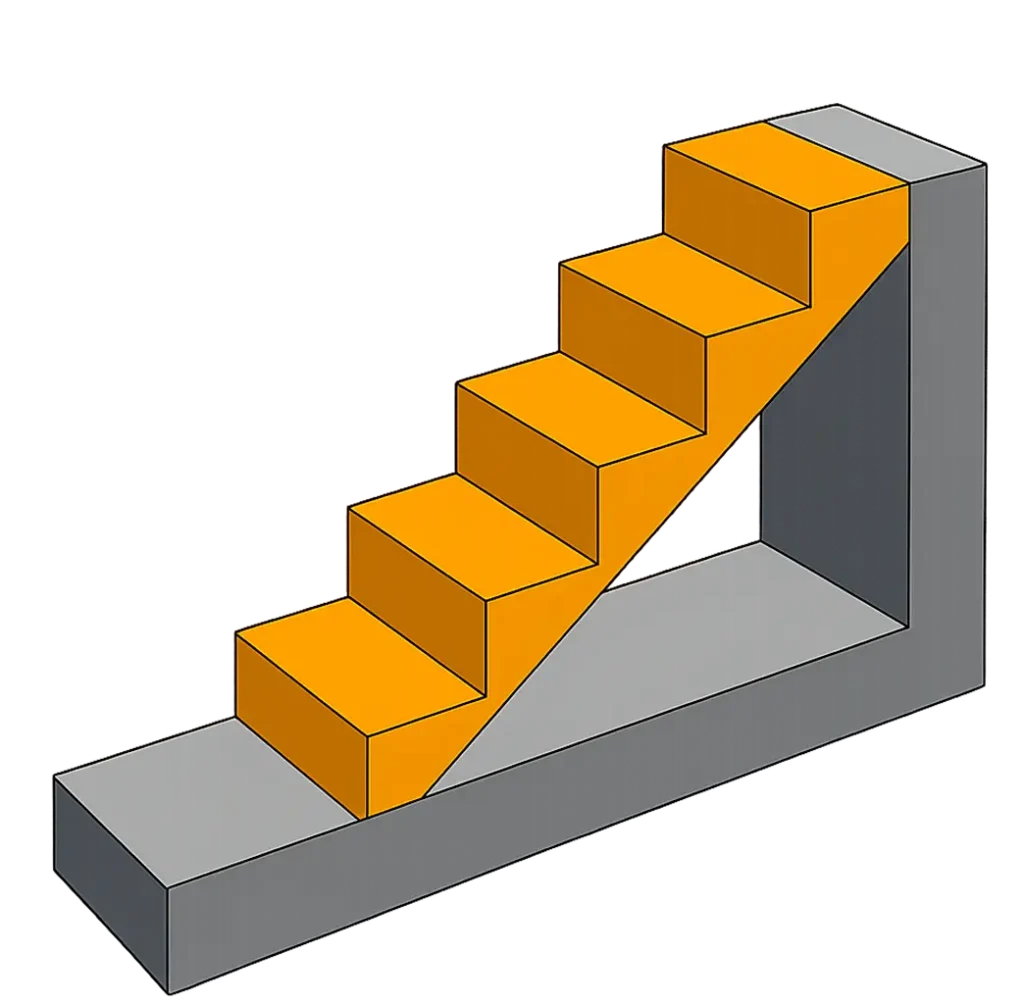
Standard Mount
The upper floor or landing forms the final level, so the top tread is one rise below it.
- Normally one fewer tread than risers.
- Use when the upper floor provides the final walking surface.
- Affects tread count, total run and stringer calculation.
UK private stair rise, going and pitch limits
The calculator uses separate guidance profiles because stair guidance is not identical throughout the United Kingdom. The table below summarises the private-stair dimensions checked by this tool.
UK private stair rules at a glance
Private-stair limits are not identical across the UK. England uses a 150–220mm rise and 220–300mm going. Wales states a maximum 220mm rise and minimum 220mm going, with permitted rise-and-going combinations in Approved Document K. Scotland uses a 100–220mm rise and minimum 225mm going. Northern Ireland uses a 75–220mm rise and minimum 220mm going. All four reviewed profiles use 2R + G of 550–700mm, a maximum pitch of 42 degrees and normal headroom of 2,000mm.
Profile | Rise checked | Going checked |
|---|---|---|
England | 150–220mm | 220–300mm |
Wales | Maximum 220mm; permitted combinations apply | Minimum 220mm; permitted combinations apply |
Scotland 2026 | 100–220mm | Minimum 225mm |
Northern Ireland | 75–220mm | Minimum 220mm |
These are selected dimensional checks for private stairs. Other stairs can have different limits. The complete guidance also covers landings, tapered treads, guarding, handrails, open risers, doors, access, fire safety and other matters that this calculator does not assess.
Worked UK stair calculation example
Suppose the finished floor-to-floor rise is 2,670mm and the individual going is 240mm. Using 14 equal risers gives an actual rise of 190.7mm:
Number of risers = 14
Actual rise = 2,670 ÷ 14 = 190.7mm
Number of treads for a standard flight = 14 − 1 = 13
Total horizontal run = 13 × 240 = 3,120mm
2R + G = (2 × 190.7) + 240 = 621.4mm
Pitch = arctan(190.7 ÷ 240) ≈ 38.5°
For the England private-stair profile, those rise, going, 2R + G and pitch values sit within the ranges checked by the calculator. Headroom, landings, handrails, guarding, structure and the rest of the design still need separate review.
Stair calculator terms explained
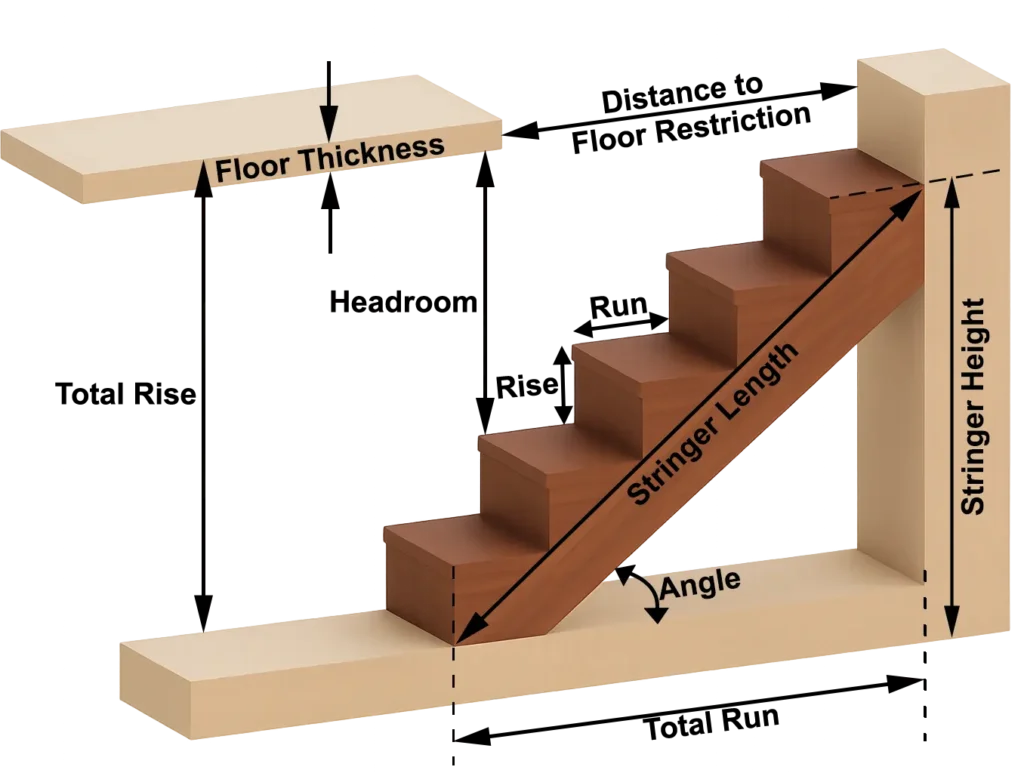
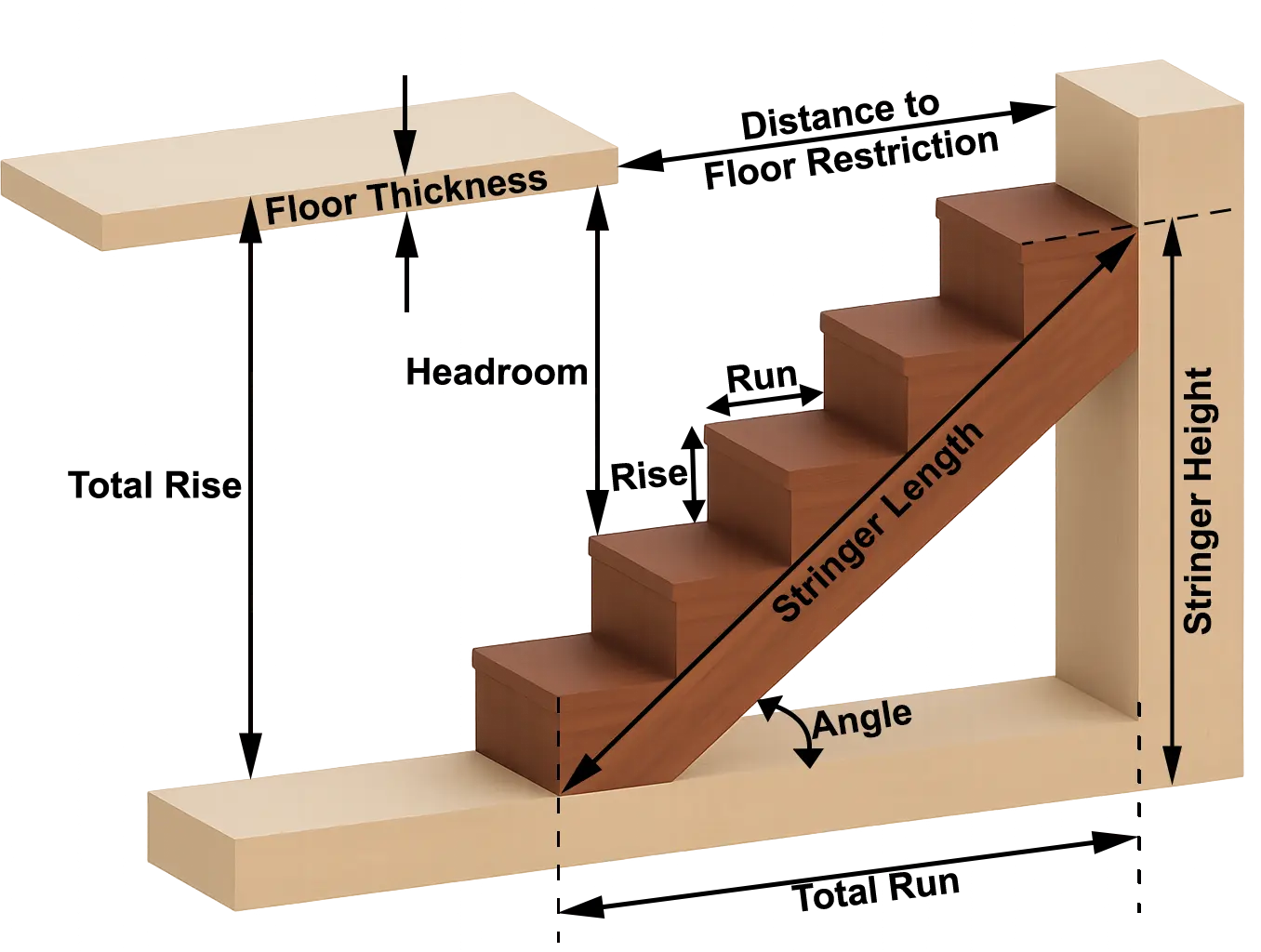
Total rise is the finished floor-to-floor height. Individual rise is the vertical height between consecutive tread levels. Going is the horizontal nosing-to-nosing distance. Total run is the horizontal length of the flight. Pitch is the stair angle. Stringer length is the calculated sloping length of the supporting member.
How the stair calculator works
Number of risers and treads
A riser is the vertical interval from one tread level to the next. In automatic mode and when only a fixed riser count is used, the calculator divides the total rise across the selected count. In Fixed Rise mode, the original calculation engine preserves the entered regular riser height and may report a different first-step rise to reconcile the total height. The UK guidance panel flags a non-uniform result; do not treat it as acceptable for construction. For a standard straight flight ending at the upper floor, the number of treads is normally one fewer than the number of risers. A flush mounting arrangement can use a different tread count.
How many stair risers and treads do I need?
For an equal-riser layout, divide the finished total rise by a practical target rise, round to a whole riser count, then divide the total rise by that count. For example, 2,600mm divided by 14 gives 185.7mm per riser. A standard straight flight normally has one fewer tread than risers, so 14 risers usually means 13 treads.
Individual rise and going
The individual rise is the vertical height of one step. The going is the horizontal distance from one nosing to the next, measured on the walking line for a straight stair. “Run” is often used informally, but UK guidance uses “going”. Total horizontal run means the overall horizontal distance occupied by the calculated flight.
The 2R + G stair formula
The expression 2R + G means twice the individual rise plus the going. It is a proportion check used in the reviewed guidance. The calculator reports the result in millimetres and compares it with the 550–700mm range used by the selected private-stair profile.
What is the 2R + G stair formula?
2R + G means twice the individual rise plus the going. For example, a 190mm rise and 250mm going gives (2 × 190) + 250 = 630mm. The reviewed private-stair guidance profiles use a 2R + G range of 550–700mm.
Pitch angle
Pitch is calculated from the individual rise and going: pitch = arctan(rise ÷ going). A smaller going or larger rise makes the stair steeper. The private-stair profiles in this calculator use a maximum pitch of 42 degrees, but a value below the maximum is not automatically suitable for every user or building.
What is the maximum pitch for a private stair?
The reviewed private-stair guidance profiles use a maximum pitch of 42 degrees. A stair can still fall outside guidance below 42 degrees if its rise, going or 2R + G value is outside the selected limits. Do not automatically combine the maximum rise with the minimum going.
Stringer length
The stringer length is the sloping distance calculated from the relevant stair height and total horizontal run using the Pythagorean theorem. It is a geometric estimate. Actual cutting, bearing, material size, connections, trimming and structural capacity require a suitable construction detail and professional judgement where necessary.
Tread thickness and nosing
Tread thickness can affect the stringer cut at the first and last step. Nosing is the tread projection beyond the riser face. The calculator keeps the individual going as the nosing-to-nosing dimension and uses the nosing input when estimating the overall footprint. Measure and detail the finished stair consistently.
Headroom and floor opening
Normal stair headroom is measured vertically above the pitch line or tread position, depending on the guidance detail. The calculator uses a simplified straight-line model to estimate either the floor opening needed for an entered headroom or the headroom available for an entered opening. It assumes a straight flight and a level floor obstruction.
Use the headroom result as an early planning check only. Real projects can be affected by floor build-up, beams, trimmers, soffits, finishes, landings and measurement position. England and Wales also include limited loft-conversion guidance that cannot be represented by one general 2,000mm check.
How much stair headroom is normally required?
Normal clear headroom is 2,000mm, measured vertically above the pitch line of the flight and over the landing. Limited alternatives can apply to some loft or roof-space conversions. Check the current guidance for the relevant UK nation and confirm the proposal with Building Control.
Guidance differences across the UK
England
For the private-stair profile reviewed in Approved Document K, the calculator checks a 150–220mm rise, 220–300mm going, 550–700mm for 2R + G, a maximum pitch of 42 degrees and normal headroom of 2,000mm. The document does not state a general minimum width for every private stair in the main dimensional table.
Wales
Welsh Approved Document K uses a maximum private-stair rise of 220mm, a minimum going of 220mm, 2R + G of 550–700mm and a maximum pitch of 42 degrees. It also provides preferred rise-and-going combinations. The calculator performs the broad dimensional checks and links to the official document for the complete detail.
Scotland
The April 2026 Scottish domestic handbook profile used here checks private-stair rise from 100–220mm, a minimum going of 225mm, 2R + G of 550–700mm and a maximum pitch of 42 degrees. Common stairs and other stair categories use different guidance and should not be assessed with the private-stair profile.
Northern Ireland
Northern Ireland Technical Booklet H gives a private-stair rise range of 75–220mm, a minimum going of 220mm, 2R + G of 550–700mm and a maximum pitch of 42 degrees. It also contains private-stair width provisions that differ from the simplified advice often repeated for England and Wales.
Common stair measurement mistakes
- Measuring structural floor levels instead of finished floor levels.
- Rounding an individual rise first and allowing the final riser to absorb the difference.
- Confusing going with the full physical tread board depth.
- Using the number of risers as the number of treads without considering how the flight meets the upper floor.
- Ignoring added floor, tread or tile thickness after the stringer has been set out.
- Entering a total run in metres while the field is set to millimetres, or vice versa.
- Treating a straight-flight result as a design for winders, landings or turns.
- Checking pitch but not headroom, guarding, handrails, landings or structural support.
Frequently Asked Questions
Methodology and official sources
The calculator converts all entered measurements into millimetres before performing the calculation. Depending on the selected input method, it calculates the number of risers, individual riser height, number of treads, going, total run, staircase pitch and stringer length.
In automatic mode, the total rise is divided across the calculated number of risers. When a fixed number of steps is selected, the calculator distributes the total rise across that riser count. When a fixed rise is entered, it uses the specified regular riser height and calculates any remaining difference as the first-step rise.
The number of treads depends on the selected mounting arrangement. Staircase pitch and stringer length are calculated using the total rise, total run and standard trigonometric methods. Optional tread thickness, nosing projection, floor-opening and headroom inputs are included only when enabled.
The UK guidance check reviews the calculated staircase against the selected jurisdiction profile. It assesses:
- Riser height
- Going
- The 2R + G relationship
- Staircase pitch
- Riser consistency
- Optional headroom
These checks provide an indicative comparison with published guidance and do not alter the calculated staircase dimensions. Results are rounded for display, while the underlying calculations use the full unrounded values.
Last reviewed: 1 July 2026. Official guidance should be checked again whenever building regulations or technical handbooks are updated and before using the results for design, construction or approval purposes.
Official sources
- England: Approved Document K — Protection from falling, collision and impact
- Wales: Approved Document K — Protection from falling, collision and impact
- Scotland: Building Standards Technical Handbook — Domestic, April 2026
- Northern Ireland: Technical Booklet H — Stairs, ramps, guarding and protection from impact
Correction notice: If you identify a calculation, wording or source issue, contact the Brick Calculator team and include the measurements entered, selected guidance profile and the result displayed.
More Free Tools You Might Find Helpful





Know Exactly How Much Concrete to Buy for Your Next Pour
The annoying part of a concrete job often starts before mixing. You have measured the space, yet the shelf offers…Plan a Safer UK Staircase: Get Rise, Going, Pitch and Dimensions Right
A staircase can satisfy a list of dimensions and still feel unsettling underfoot. The difference often appears when someone carries…How Much MOT Type 1 Do I Need? Get the Right Tonnes, Bags and Depth First Time
If you are asking “how much MOT Type 1 do I need?”, start with three numbers. You need the area,…