How Much Is Tarmac Per Square Metre in the UK? Driveway Cost Calculator Guide
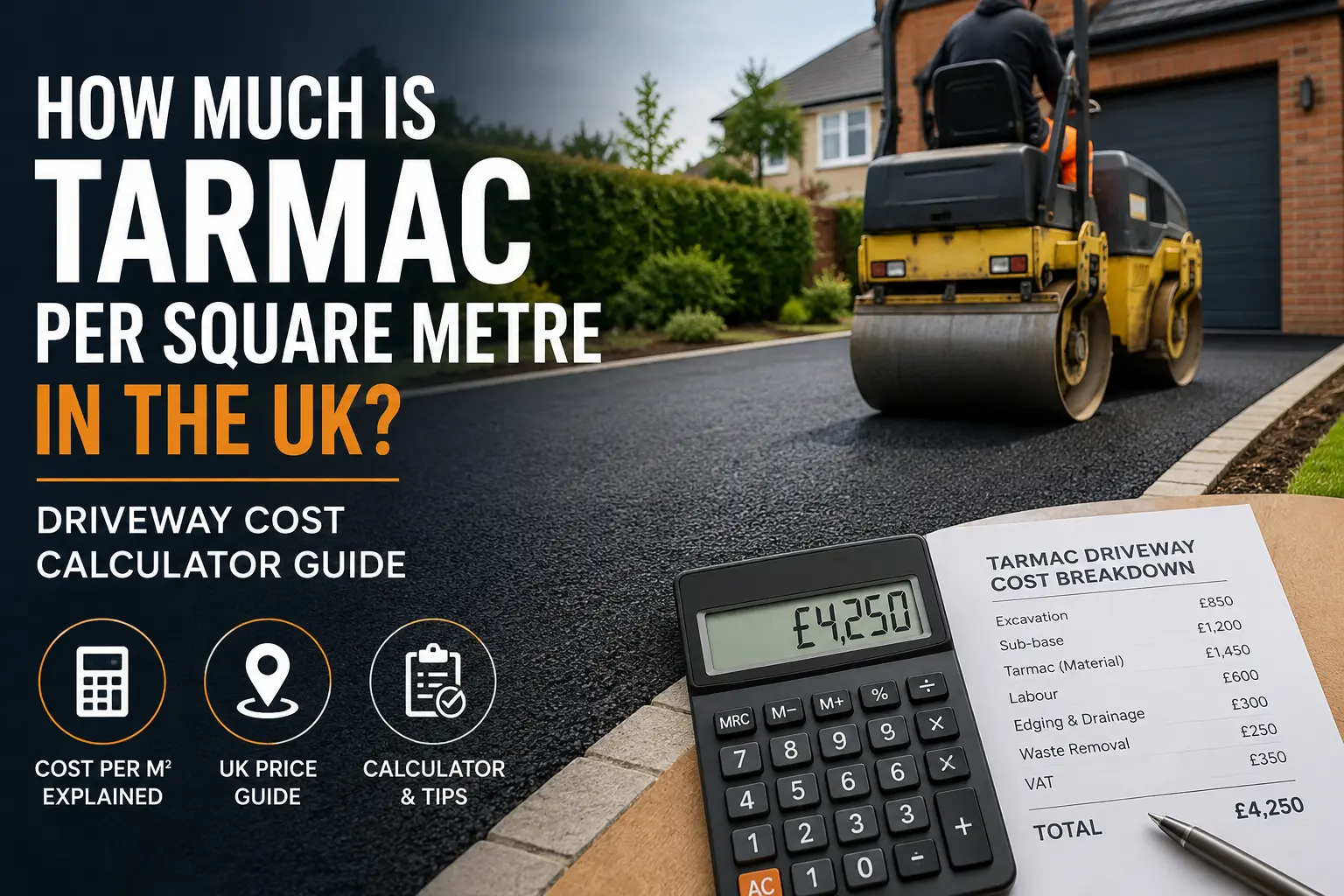
It’s 8:20 on a wet Tuesday morning in Birmingham. A homeowner has two driveway quotes sitting on the kitchen table. One says £3,450. The other says £5,900. Both are for a 60m² tarmac driveway. Both promise a tidy black finish, two to three days on site, and a “proper job”.
The smell of damp stone dust is still hanging around the old drive. The car tyres sink into loose gravel. Rainwater is already running towards the front step.
So which quote is fair?
And here’s the real question: are you paying for tarmac, or are you paying for excavation, drainage, edging, waste removal, awkward access, and a team that won’t cut corners where you can’t see them?
A typical 60m² tarmac driveway is often priced around £3,750, with many UK driveway projects falling between £1,300 and £7,500, depending on size, groundwork, and extras such as edging or drainage.
I’ll say this plainly: price per square metre helps, but it can also mislead you. A cheap quote can cost more later if the base fails, water pools, or the surface cracks after the first hard winter.
This guide shows you how to estimate the cost before you ask for quotes. You’ll see UK price ranges, regional differences, hidden extras, and a practical way to use a driveway cost calculator without fooling yourself.
How much is tarmac per square metre in the UK?
For a new UK driveway, installed tarmac usually costs around £45 to £100 per m². The final price depends on the driveway size, existing ground, excavation, sub-base, drainage, edging, access, and where you live. A simple resurfacing job may cost less than a full dig-out and new installation.
The phrase how much is tarmac per square metre sounds simple. In real life, it’s not.
The black finished surface is only the part you see. Under it, a proper driveway may need excavation, a geotextile membrane, Type 1 MOT sub-base, binder course, wearing course, compaction, edging, drainage channels, and waste removal.
That’s why two driveways with the same area can have very different prices.
Current UK cost data puts installed tarmac at around £45 to £100 per m² for a new driveway, depending on preparation work and location. A 30m² driveway may cost £1,300 to £3,200, while a 60m² driveway may cost £2,500 to £5,000. A larger 90m² driveway can reach £4,000 to £7,500.
Here’s a quick guide.
| Driveway type | Typical price guide | Best for | Main warning |
|---|---|---|---|
| Small 30m² new tarmac drive | £1,300 to £3,200 | One-car driveway | Higher cost per m² |
| Average 60m² new tarmac drive | £2,500 to £5,000 | Two to three cars | Drainage can raise cost |
| Large 90m² new tarmac drive | £4,000 to £7,500 | Four to six cars | More plant and labour |
| Tarmac resurfacing | £50 to £70 per m² | Sound existing base | Raises driveway height |
| Hot-mix tarmac supply only | £45 to £60 per tonne | Trade or large jobs | Needs fast laying |
| Cold lay tarmac | £8 to £15 per 25kg bag | Small repairs | Not ideal for full drives |
| Coloured tarmac | Add £10 to £20 per m² | Decorative driveways | Higher material cost |
My honest view: a quote that only says “tarmac driveway, £55 per m²” is not enough. You need to know what’s included under that square metre.
Why do tarmac driveway quotes vary so much?
Tarmac quotes vary because the visible surface is only one part of the job. Groundwork, old driveway removal, drainage, edging, access, driveway shape, manhole covers, layer depth, labour, VAT, and local pricing can all change the final quote. The cheapest quote is often missing something.
A flat, open driveway with a decent existing base is straightforward.
A sloped driveway with old concrete, poor drainage, tight access, and broken edging is a different job altogether.
Let’s use a real-world style example.
A homeowner in Nottingham wants a 50m² tarmac driveway over an old gravel surface. Access is easy. The ground is not too soft. There’s space for machinery. Water can run towards an existing drain. That job may sit around £3,000 to £4,500, depending on the installer and specification.
Now move the same 50m² driveway to Kent. Add narrow access, old concrete removal, a new channel drain, skip hire, and two raised manhole covers. The size has not changed, but the quote could rise by £1,000 to £2,000.
That’s why “how much is tarmac per square metre” needs context.
The main price drivers are:
| Cost factor | Why it matters |
|---|---|
| Driveway size | Larger jobs cost more overall |
| Excavation | Removing old material adds labour and skip hire |
| Sub-base | Weak ground needs more preparation |
| Drainage | Water must run away from the house |
| Edging | Holds the tarmac in place |
| Access | Tight access slows the team down |
| Region | London and South East prices are often higher |
| Finish | Coloured tarmac and borders add cost |
Tarmac layer requirements matter too. A stronger driveway may use a thicker sub-base, binder layer, and top coat. One expert example gives a residential build-up of 150mm sub-base, 50mm base coat, and 30mm top coat.
A thin job can look fine on day one.
Six months later, the tyres tell the truth.
How do you use a tarmac driveway cost calculator?
Use a tarmac driveway cost calculator by measuring the length and width in metres, entering the total area, then adding details about excavation, old surface removal, drainage, edging, region, and finish. Treat the result as a quote-checking range, not a fixed price from an installer.
Start with the basic area.
If your driveway is 8 metres wide and 6.25 metres long, the area is:
8 x 6.25 = 50m²
If installed tarmac ranges from £45 to £100 per m², your broad estimate becomes:
50 x £45 = £2,250
50 x £100 = £5,000
That range is wide, so refine it.
Use this method:
- Measure the driveway in metres.
- Split odd shapes into rectangles.
- Add the areas together.
- Add 5 to 10 percent if the shape is awkward.
- Choose whether old tarmac, concrete, gravel, or soil needs removing.
- Add drainage if water runs towards the house or public footpath.
- Add edging if the sides are open.
- Select your UK region.
- Compare the calculator result with written quotes.
You can use your calculator page naturally here: use our free tarmac and asphalt calculator.
The calculator should help you spot weak quotes. If your estimate says £4,200 and one installer says £2,600, don’t celebrate too early. Ask what’s missing.
Here’s a simple decision guide.
| If this happens | What to ask |
|---|---|
| Quote is much cheaper than expected | Is excavation included? |
| Water runs towards the house | Where will drainage go? |
| Old surface is cracked badly | Is resurfacing suitable? |
| Quote only gives one total | Can I see the breakdown? |
| Installer won’t visit the property | How can they price the ground condition? |
| Price excludes VAT | What is the final payable amount? |
For other construction materials, you can also link to your concrete calculator and brick calculator where relevant.
Is tarmac cheaper than block paving, resin, concrete, or gravel?
Tarmac is usually one of the better-value driveway surfaces in the UK. It often costs less than block paving and concrete, installs quickly, and suits everyday vehicle use. Gravel can be cheaper, resin can look smarter, and concrete can last well, but each option has trade-offs.
Here’s the comparison most homeowners need.
| Surface | Typical UK cost per m² | Strength | Weak point | Best use |
|---|---|---|---|---|
| Tarmac | £45 to £80 plus extras | Good value and quick to lay | Not naturally permeable | Practical family driveway |
| Gravel | £40 to £70 | Low upfront cost | Moves under tyres | Rural or informal drive |
| Block paving | £70 to £120 | Smart appearance | More labour and weeds | Decorative front drive |
| Resin | £60 to £95 | Clean modern finish | Needs skilled installation | Modern homes |
| Concrete | £85 to £135 | Strong surface | Can crack | Heavy use areas |
| Tarmac overlay | £50 to £70 | Lower-cost refresh | Raises finished level | Sound existing tarmac |
Tarmac often beats block paving and concrete on cost. It also goes down faster. A small tarmac driveway may be completed in one to two days, while a typical 60m² driveway often takes two to three days. Larger or more awkward projects may take three to five days.
But don’t choose tarmac only because it’s cheaper.
Tarmac is not naturally permeable. If water drains onto a public footpath or towards the house, you may need drainage work. For front gardens in England, non-permeable surfacing over 5m² can need planning permission unless water drains to a permeable area within the property. Dropped kerbs also need local authority approval.
That’s where some cheap tarmac quotes fall apart. They price the surface, not the water.
Can resurfacing save money compared with a full new tarmac driveway?
Yes, resurfacing can save money if the existing tarmac base is still sound. It usually costs less than digging out and rebuilding the whole driveway. But resurfacing over a failed base is false economy. Cracks, dips, movement, and drainage problems need fixing first.
Resurfacing means laying a new tarmac layer over the existing surface. It can freshen up an old drive and extend its life without full excavation.
Current cost data puts tarmac resurfacing at around £50 to £70 per m², depending on driveway size, location, and condition.
That sounds attractive.
But here’s the catch. Resurfacing adds height. Too many layers can raise the driveway close to the damp-proof course, air bricks, garage threshold, or front step. One guide warns that each resurface can add around 30mm to the driveway height.
Use this simple test before you choose resurfacing.
| Existing driveway condition | Best option |
|---|---|
| Surface faded but flat | Resurfacing may work |
| Small cracks only | Repair then resurface |
| Deep cracks across the drive | Full inspection needed |
| Dips where tyres park | Base may have failed |
| Water pools after rain | Fix drainage first |
| Edge is breaking away | Rebuild edging before overlay |
I’m not against resurfacing. Done in the right place, it’s sensible.
But resurfacing a bad driveway is like painting over damp plaster. It looks better for a short time, then the old problem comes back.
How much does tarmac cost per tonne?
Hot-mix tarmac usually costs around £45 to £60 per tonne on a supply-only basis. One tonne may cover around 8m², depending on the depth laid. Supply-only prices do not include labour, delivery, sub-base, compaction, waste removal, or driveway preparation.
This is where many DIY estimates go wrong.
They find a tonne price, multiply it by the area, and think they’ve priced the job. That only prices part of the material.
Hot-mix tarmac is sold by the tonne and has to be delivered hot. It must be laid and compacted quickly before it cools. Cost data shows hot-mix tarmac at around £45 to £60 per tonne, with one tonne covering roughly 8m², depending on depth.
Cold lay tarmac is different. It’s sold in bags and is better for small repairs, potholes, and patches. A 25kg bag usually covers only a small area at shallow depth, so it’s poor value for a full driveway. Cold lay tarmac is listed around £8 to £15 per 25kg bag, while hot-mix tarmac is listed around £45 to £60 per tonne.
Here’s a quick example.
A 40m² driveway surface layer may need around 5 tonnes if using the rough 8m² per tonne guide.
5 tonnes x £60 = £300 material supply
Sounds cheap, doesn’t it?
But that excludes labour, plant, delivery, sub-base, excavation, drainage, edging, skip hire, VAT, and profit. That’s why supply-only maths should never be used as a full driveway estimate.
What should a proper tarmac driveway quote include?
A proper tarmac quote should include the measured area, excavation depth, waste removal, Type 1 MOT sub-base, compaction, binder course, wearing course, edging, drainage, manhole covers, access notes, VAT, guarantee, and expected timescale. If those details are missing, ask before you agree.
A good quote is boring in the best way. It tells you exactly what you’re buying.
Ask these questions before saying yes:
- How many square metres have you measured?
- How deep will you excavate?
- What sub-base will you use?
- Will there be a binder course and wearing course?
- Where will the rainwater go?
- Is edging included?
- Are manhole covers included?
- Is skip hire included?
- Is VAT included?
- How long before we can park on it?
- What guarantee is given in writing?
Drainage deserves special attention. A new soakaway or drainage channel for a standard driveway can start around £1,000, and poor water flow can wear away the tarmac surface over time.
That is not a small extra. It can change the quote completely.
My strongest advice is this: get at least three written quotes, but don’t choose by total price alone. Choose by scope.
A £4,800 quote that includes proper excavation, drainage, edging, and VAT may be better value than a £3,600 quote with vague wording.
When is the best time to book a tarmac driveway in the UK?
Spring to early autumn is usually the easiest period for tarmac work because there are more dry, mild days. Winter jobs can still be done, but rain, frost, cold ground, and short daylight hours can slow the work and affect scheduling. Book early if you want better availability.
Tarmac work depends on timing. The surface needs to be laid and compacted while the material is workable. The team also needs a prepared base and suitable weather.
A typical day starts early. The old surface comes up. The digger scrapes. The compactor thuds across the stone. By the time the hot-mix arrives, the crew needs to move quickly. The smell is sharp. The roller hums. The finish has to be right before the surface cools.
Here’s a seasonal guide.
| Month range | What to expect | Best action |
|---|---|---|
| January to February | Cold, wet, more delays | Plan and gather quotes |
| March to May | Better working conditions | Good time to book |
| June to August | Busy period | Book early |
| September to October | Often a strong window | Good balance of weather and demand |
| November to December | Higher weather risk | Use only reliable installers |
After laying, hot-mix tarmac can often handle foot traffic and light vehicles after 24 to 48 hours, but normal use may be better after around 7 days. Full curing can take longer.
So don’t plan a new driveway the day before guests arrive.
Give it breathing room.
Final answer: what should you expect to pay?
Most UK homeowners should expect installed tarmac to cost around £45 to £100 per m² for a new driveway, with a typical 60m² drive often landing around £2,500 to £5,000. Resurfacing may cost less, but only when the existing base is sound and drainage is already under control.
If you came here asking how much is tarmac per square metre, use this as your working answer:
For a simple new driveway, budget £45 to £100 per m².
For resurfacing, budget around £50 to £70 per m².
For a typical 60m² driveway, expect roughly £2,500 to £5,000, depending on preparation and finish.
But don’t stop there.
Measure your driveway. Use a tarmac driveway cost calculator. Add groundwork, edging, drainage, and waste removal. Then get written quotes from local driveway specialists.
The best quote is not always the cheapest one.
It’s the one that explains the work under the surface.