
Stair Calculator
More Free Tools You Might Find Helpful





More Free Tools You Might Find Helpful
Bricklaying Costs 2026: The Complete Price Guide for Materials & Labour
Introduction: The 2026 Price Landscape After a rough few years on the tools, things have finally calmed down a bit…The Ultimate UK Guide to Spalling Bricks and How to Fix Them
The Ugly Truth About Blown Bricks I have spent well over 14 years on building sites across the UK and…Popular Brick Bonds: Choosing Between Stretcher, Flemish, and English Bonds
Introduction When you’re standing on site, a brick wall is never just a pile of clay stacked up. It’s a…



Introduction
You know that feeling? When you look at your total rise measurement and the building code books and your brain just kinda melts? Yeah, we’ve all been there. It’s not just the fear of messing up the math, it’s the fear of building a messy step that someone trips on later. Well, this article is the antidote to that panic.
Forget those dry, complicated blueprints. We’re gonna break down every single concept that this tool of ours simplifies. We’re talking about the deep stuff, like why your riser height needs to be what it is, and why the run depth is absolutely critical for comfort. We’ll look at the safety codes which, honestly, are just common sense rules to stop accidents and we’ll cover the design choices too, like figuring out if a modern “flush” top step makes sense for your space, or if you need the standard kind. It’s all about giving you the confidence so you know for sure that what you’re building is safe, fully compliant, and just plain good to walk up.
Setting the Foundation: Choosing Your Units and Layout
Right then, let’s get the foundation laid before we start pouring the concrete. When you first sit down to design a staircase, you’re immediately faced with two big choices: units of measurement and layout. Look at the calculator just above, see those toggles? They’re there for a reason. Don’t waste time trying to convert five feet, nine and a quarter inches into millimeters on a scrap of paper or pocket calculator, that’s just inviting errors. Choose your unit, be it Metric (m/mm) or Imperial (ft. /inch), and stick with it from the jump.
Standard Mount
The last step is one step below the upper floor level, the upper floor itself is treated as the last step.
- Your total number of risers one more than total number of steps.
- Often easier to frame on decks.
- Helpful when space is tight.
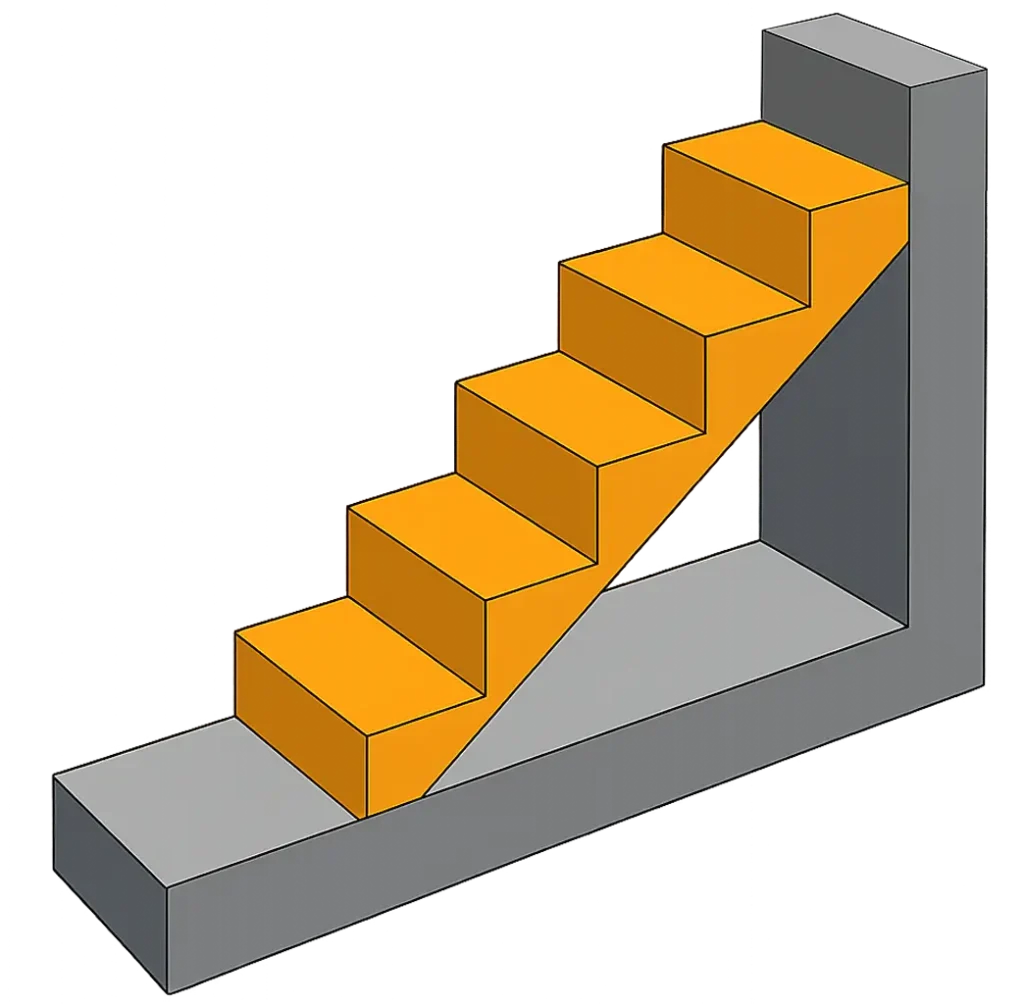
Flush Mount
The top step is at the same height as the upper floor/ deck landing.
- Total number of risers and steps are same.
- Gives a clean, continuous line of steps right up to floor level.
- The transition feels smoother.
- It requires high skills to frame.
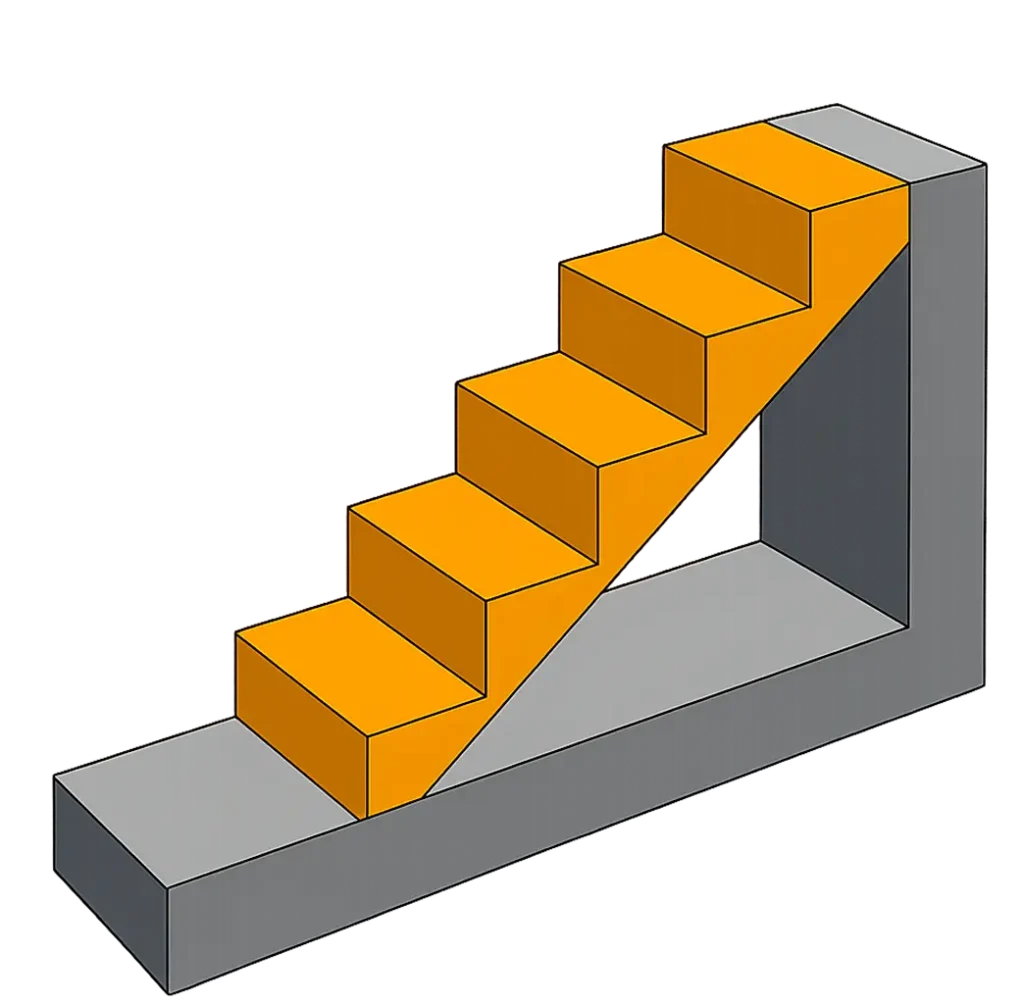
Stairs Terminologies
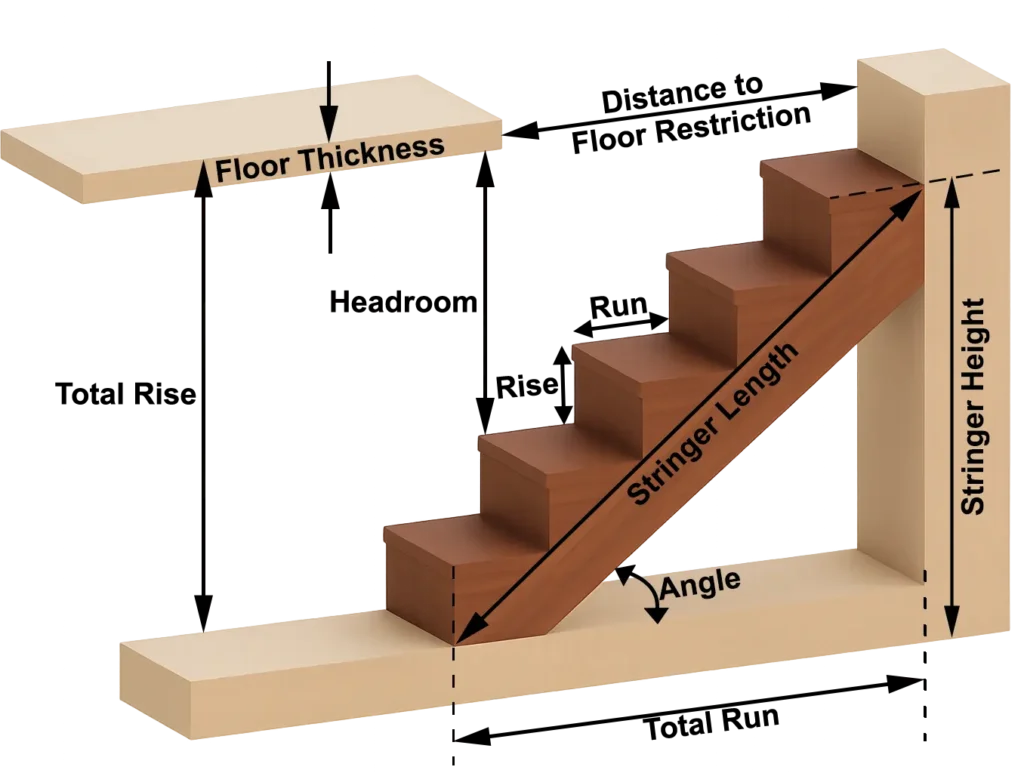
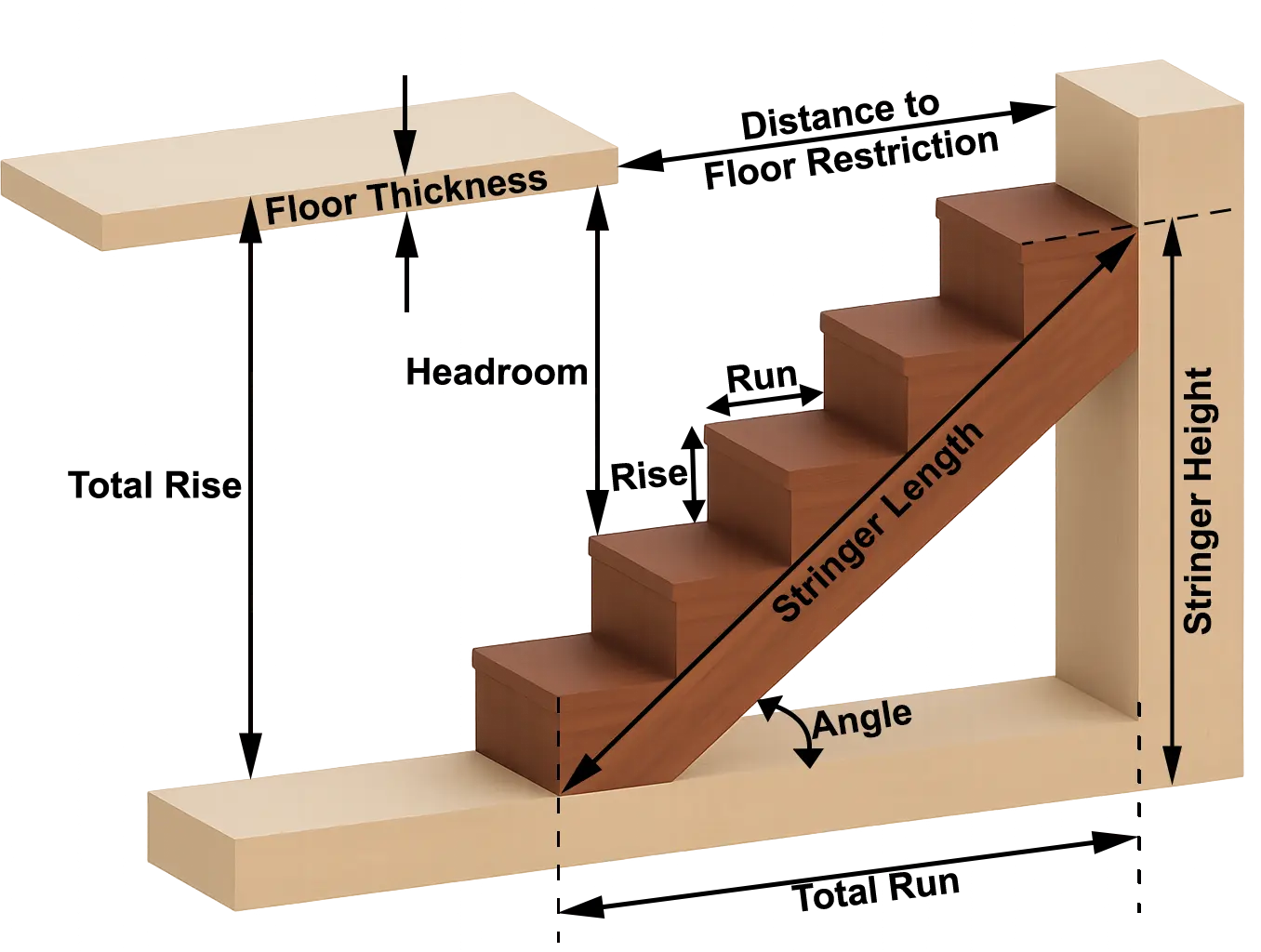
When you use this stairs calculator, there are four main measurements you really need to understand. If you get these right, most of the stair design becomes much easier.
Total Rise
Total rise is the vertical distance from the finished floor below to the finished floor above. Not the concrete or structure, but the final surface you will walk on. On site I always measure this in a few different spots, because floors are rarely perfectly level. If you only measure once and it is slightly off, you can end up with small differences in step heights later, and that usually causes problems.
Total rise = number of risers × rise per step
Total Run
Total run is the horizontal length that the staircase will cover. Think of it as how far the stair comes out along the floor, not counting any landings or extra openings. This is the key number when you plan the opening in a floor or check if the stair will fit in a small space like a corridor. If the total run is too short, the stairs become steep and uncomfortable.
Total run = one run × number of steps
Riser (Rise Height)
One step rise is simply how high your foot lifts from one step up to the next. It sounds an easy thing, but this is the point where things start to get very wrong. Every single rise should be the same, from the very first step at the bottom to the last one at the top.
Important!
According to IBC:
Riser between: 4 in and 7 in ( 102–178 mm)
Important!
According to IRC:
Max riser height: 7¾ in (197 mm),
Min riser height: 4 in (102 mm)
Step Run (Run/ Tread Depth)
Step run is the depth of your stair step, the part your foot actually stands on. If this depth is too small, you do not feel secure when you go down the stairs, especially when you are carrying tools, boxes or materials. Building codes usually give a minimum tread depth for safety, and from experience I suggest you stay at or above that value. A good tread depth makes the staircase feel natural and easy to use.
Important!
According to IBC:
Tread depth: at least 11 in (≈ 279 mm)
Important!
According to IRC:
Min tread depth: 10 in ≈ 254 mm
Stair Nosing
When the tread is installed, it usually extends a little past the riser (the vertical part). That extra bit sticking out at the front is what we call the stair nose. This overhang is another subtle but important safety feature. This small overhang increases the effective run depth for your foot without making the overall staircase longer.
Head Room
Headroom is the clear vertical space above the stairs, from the stair tread up to the standard ceiling height or any structure above. It’s the space that lets people walk without hitting their head.
Stair Stringer Calculator
The stringer is the long sloping piece that the whole stair rests on (flight of stairs). It runs from one floor to the other and carries every tread and riser, so if the stringer is wrong, the stair just feels wrong too. In the calculator we mostly care about its height, length and angle. Height is the total rise R, the floor-to-floor distance. The total run T is how far the stair goes out horizontally. From those two the tool finds stringer length with Pythagoras theorem
Stringer length = √(Total rise2 (R) + Total run2 (T))
- Stringer height= Total rise (in case of flush Mount)
- Stringer height= Total rise – Step Rise (in case of Standard Mount)
- Stair stringer angle comes from
- θ = arc tan(R / T)
- Angle = arctan (Total rise / total run)
Important!
Safe stringer angle is usually, around 30°–37° from horizontal plane.
The 2r + t Rule for Stair Design
The “2:1 Rule” (or 2r + t rule) is an empirical formula used to ensure that a stair feels comfortable, safe, and easy to ascend and descend. It relates the rise (r) of a step (the vertical distance) to the tread (t) of a step (the horizontal depth). The rule is expressed as
2r + t = 25 inches (or 63 cm)
Where:
r = Rise (Riser height), t = Tread (step depth), 25 inches = a constant value within a comfortable range.
What is the 27 rule for stairs?
The rule is based on the biomechanics of walking and climbing. A person naturally uses twice as much energy to lift their body vertically (the rise) as they do to move it horizontally (the tread). The formula essentially aims to keep the total “effort” (or stride length) per step constant.
If 2r + t is too small
The stair feels stumbling or too steep. The steps are cramped, making your stride short and forcing you to lift your knee high.
If 2r + t is within the ideal range
The stair feels natural and comfortable. Your body’s natural stride rhythm is maintained whether climbing up or down.
If 2r + t is too large
The stair feels awkward or stretching. The steps are too long and shallow, forcing a long, unnatural stride that can lead to missteps.
Example: If a comfortable stair has a Rise (r) of 7 inches and a Tread (t) of 11 inches:
2(7) + 11 = 14 + 11 = 25 inches
Since 25 inches falls within the comfortable range, this stair would generally feel very natural and easy to use.
Whole Steps, No Weird Fractions
Another key job is finding a clean whole number of steps. The tool works out how many steps you need so the total rise is split evenly, no odd half step at the top or bottom like. Those steps are where people catch their toe. Sticking to whole numbers reduces trip risk and also saves you from wasting material trying to “fix” things later.
How to Use Stair Calculator
Steps | What to Do? | Details |
|---|---|---|
Step-1 | Select your units | Choose whether you want to work in feet & inches (or meter/mm) at the top of the calculator. |
Step-2 | Pick the mount type | Choose Standard or Flush mount, depending on how your stringer stair will attach to the top floor |
Step-3 | Choose the run input mode. |
|
Step-4 | Enter the total rise and run. |
(Note: you can hit enter at this point and calculator will give you your optimum stair calculation or move to more customized input values) |
Step-5 | Set optional rise / step controls. | Under “Optional Input Values”, choose one of these if you want more control:
|
Step-6 | Configure tread options (optional) | Turn Tread ON if you want to include tread thickness in the calculation, then enter the tread thickness in inches/mm. |
Step-7 | Set nosing options (optional). | Turn Nosing ON if your steps will have a nosing.
|
Step-8 | Use the headroom constraint (optional). | Turn Headroom Constraint ON if you need to check clear headroom. Then choose:
|
Step-9 | Click “Calculate” | Press the Calculate button. The tool will generate stair layouts based on your inputs. |
If you want to design concrete stairs and want to know the materials for it,
Use these values to check comfort (riser height and tread depth), space (total run and angle), and what materials you need (stringer length, number of stair treads, tread thickness).
Advanced Safety Features
Consistent Rise
All steps should have uniform riser height. Even small changes in rise can feel like a “Missing step” and increase the risk of trips and falls.
Proper Headroom
Stairs need clear headroom from the tread to ceiling, so people don’t have to duck or in worst case smash their head. In most cases, aim for at least 80 inches (about 2.0 m) of vertical clearance.
Handrails
Stair rail on one or both sides give you something solid to grab, and that really matters for kids, older folks, or just anyone who’s a bit tired and clumsy after a long day. You don’t really notice them when things are fine, but you’re glad they’re there when you miss a step.
Lighting
is a big one too. If the landings and the front edge of each step are well lit, it’s much easier to see where one tread ends and the next one starts. No guessing, no “is that the last step?” moment in the dark.
Non-Slip Surface
Give your stairs a surface that grips. Use non-slip treads and keep the surface dry. A bit of texture, engraving, grip tape, or a stair runner can prevent slips.